India–USA Trade and Receivables
General information, not legal or financial advice. Terms of Use.
On this page
- The corridor in one page
- Section I · Diagnose before you escalate
- Archetype 1 · The quality hold
- Archetype 2 · The regulatory freeze
- Archetype 3 · The withholding short-pay
- Archetype 4 · The cash-crunch rollover
- Archetype 5 · The vanishing distributor
- Section II · Building the contract that makes…
- II.1 The clause that matters most
- II.2 The other seven clauses
- II.3 Security that actually works in this…
- Section III · The first ninety days past due
- Section IV · Choosing the legal route
- Section V · Machinery specific to the…
- V.1 If you must litigate in the United States
- V.2 Section 1782 discovery — and its real limits
- V.3 Compliance discipline in recovery
- V.4 When the buyer is the Indian arm of a US…
- Section VI · What this costs and how long it…
- Section VII · Questions US credit managers ask
- What this guide cannot tell you
- Annex · The US exporter's India file
A field guide for American exporters, credit managers and collection professionals with an Indian buyer who has stopped paying
The corridor in one page
The United States and India trade heavily and asymmetrically. American sellers into India are concentrated in aerospace components and MRO, industrial and process machinery, semiconductors and electronic components, medical devices and diagnostics, specialty chemicals and polymers, software and cloud services, almonds and pulses, and scientific instruments. Indian buyers are a mix of large listed groups, a very deep promoter-led mid-market, and a distributor layer that sits between the two.
Three structural features of this corridor determine everything about collection:
One. Terms have loosened. Documentary credit was once the default for US–India shipments; open account at 30, 60, 90 and increasingly 120 days is now normal for established relationships, and documents-against-acceptance is common in the middle. The security that used to sit inside the payment mechanism has largely been removed, and nothing has replaced it.
Two. The distributor layer is thin on capital. A great many US products reach Indian end-users through a national or regional distributor whose balance sheet is a fraction of the credit line extended to it. When the end-user pays slowly, the distributor does not have the working capital to bridge, and the exporter becomes the involuntary financier of the whole chain.
Three — the one that matters most — the United States is not a reciprocating territory for the enforcement of judgments in India.
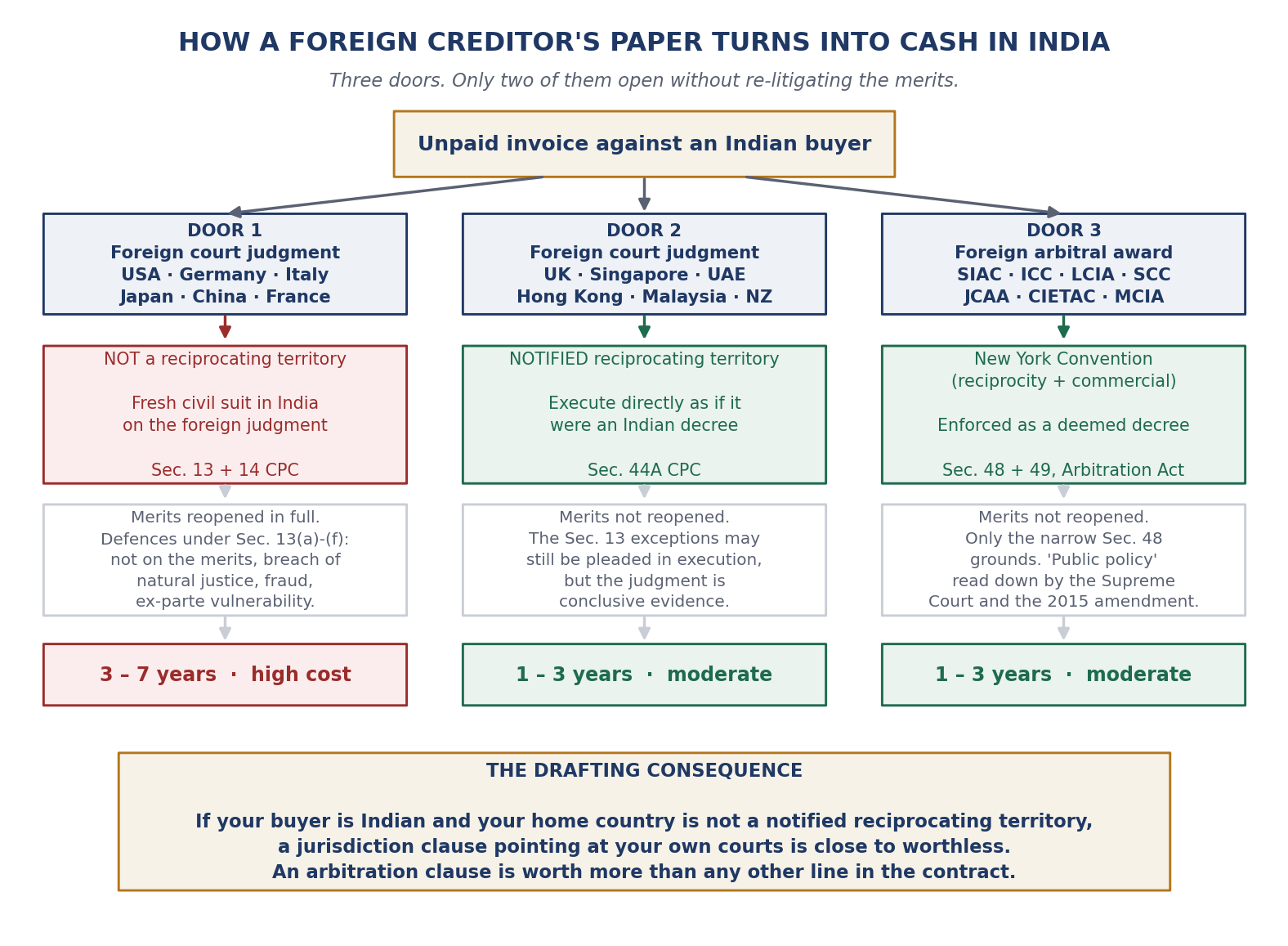
The full mechanics of each door — Sections 13, 14 and 44A CPC, and Sections 47 to 49 of the Arbitration and Conciliation Act — are set out in Part 1 of the pillar reference.
Section I · Diagnose before you escalate
Most US credit teams treat every Indian overdue as the same event and apply the same escalation. It is not the same event. In this corridor, non-payment falls into five recognisable patterns, and the correct response to each is different — in three of the five, escalation makes things worse.
Work out which one you have before you send anything.
Archetype 1 · The quality hold
Signature. Payment was moving normally. Then, at 45 or 60 days past due, a complaint arrives: short shipment, moisture, out-of-specification analysis, damage in transit, wrong revision level. Often the complaint arrives within days of your first firm demand.
What it usually is. Two different things wearing the same coat. Either a genuine quality problem your QA can resolve, or a manufactured dispute deployed to buy time. The tell is timing and specificity: a genuine complaint is raised close to clearance, names lot numbers and quantities, and comes with photographs or a third-party report. A manufactured one is raised after your demand, is vague, and covers the whole account rather than a consignment.
Why it is dangerous. Under Mobilox Innovations v. Kirusa Software, a pre-existing dispute raised before your demand notice will defeat a Section 9 application under the Insolvency and Bankruptcy Code. A single ambiguous email in your own inbox can close off the strongest instrument you have.
The move.
- Isolate. Split the ledger into the disputed consignment and the undisputed balance, in writing, and demand the undisputed balance separately. Most quality holds cover a fraction of the account and are being used to hold all of it.
- Answer the complaint on the technical merits with your pre-shipment inspection and test certificates. This is what those certificates are for.
- If the complaint is genuine, settle it fast with a credit note and get the balance paid. A quality dispute that stays open for six months becomes a receivables dispute permanently.
- Record the outcome in a jointly signed reconciliation. That single document may start a fresh limitation period if the acknowledgement meets Section 18. It destroys the pre-existing-dispute defence for everything it covers. For that limitation effect, the acknowledgement must recognise the relevant liability in writing and be signed before expiry by the liable party or its duly authorised agent; any fresh period runs from signing.
What fails. Ignoring the complaint and escalating anyway. You will find it quoted back to you at the NCLT eighteen months later.
Archetype 2 · The regulatory freeze
Signature. The buyer is not arguing about the debt. The buyer is apologetic, sometimes embarrassed, and keeps saying the payment is "with the bank" or "at customs". Nothing moves for weeks.
What it usually is. One of four blockages, none of which is a refusal to pay:
- The remittance is stuck at the authorised dealer bank. Indian import payments run through an AD bank under the RBI's Master Direction on Import of Goods and Services, and the bank must obtain evidence of import, monitored through the Import Data Processing and Monitoring System (IDPMS). If the Bill of Entry has not been uploaded, or the invoice value and the BoE value differ, the bank will not release the remittance.
- The goods have not cleared customs. A missing BIS certification or a product now covered by a Quality Control Order, an incorrect HS classification, an anti-dumping duty the buyer did not price for, or an origin certificate defect. The buyer is paying demurrage on your container and will not pay for it as well.
- The buyer has exhausted an import limit or has outstanding IDPMS entries against earlier consignments from other suppliers.
- A licence issue — restricted-item import authorisation, a lapsed IEC, or a listing on the DGFT Denied Entity List.
The move. Ask the direct question, in writing, to the buyer's finance head: "Which AD bank is processing this remittance, and what document is it waiting for from us?" It is answered more often than American credit teams expect. The fix is usually a corrected commercial invoice, a signed amendment reconciling invoice value to BoE value, or a certificate you can produce in a week.
What fails. A demand letter. This buyer wants to pay and cannot. A letter from your lawyer solves nothing and burns a relationship that is about to become productive again.
Archetype 3 · The withholding short-pay
Signature. The remittance arrives, and it is short by roughly ten to twenty per cent. The buyer says the deduction is "TDS". Your AR team codes it as a dispute and it sits unresolved for a year.
What it is. Section 195 of the Indian Income-tax Act obliges the Indian payer to deduct tax at source on sums chargeable to tax in India, and makes the payer personally liable if it fails to. Buyers therefore deduct defensively whenever an invoice looks like anything other than a pure sale of goods — installation, commissioning, training, support, software, engineering, or a service element bundled into a machine sale.
Why this corridor sees it more than most. The India–US Double Taxation Avoidance Agreement uses a "make available" test for fees for included services under Article 12: technical services are taxable in India only where the service makes technical knowledge, experience, skill or know-how available to the recipient such that they can apply it independently. Whether your installation supervision or annual support crosses that line is a real question, and Indian buyers resolve it conservatively — against you.
The move.
- Supply a current Tax Residency Certificate from the IRS (Form 6166), a completed Form 10F, and a no-permanent-establishment declaration. Do it annually, before the first invoice of the year, not after the first short payment.
- Unbundle. Invoice goods separately from services, with the service scope described in language that engages the "make available" test correctly.
- Require the buyer to furnish the withholding certificate (Form 16A) so you can claim foreign tax credit at home. Money withheld and properly certified is not lost, it is deferred.
- Put the allocation in the contract.
What fails. Treating it as a collection matter. It is a tax-characterisation matter and it belongs with your tax people, not your AR team.
Archetype 4 · The cash-crunch rollover
Signature. Part payments arrive, always smaller than promised and always late. Promises are made by the accounts department and broken. New orders keep coming — the buyer wants to keep trading.
What it is. A solvent business with a working-capital hole. Its own customers are slow, its bank limits are fully drawn, and it is deciding each Friday which suppliers to pay. Your position in that queue depends on how clearly your claim reaches the decision-maker and what commercial support you can withhold, not on how long you have waited.
The move. This is the archetype where the commercial ladder pays, and where legal process is a waste of money.
- Go over accounts payable. Find the director from the MCA DIR-12 records and address the demand to that individual, by name, at the registered office as filed. In a promoter-led Indian company, accounts payable executes a decision; it does not make one.
- Use the lever you already hold. Suspend spares, warranty service, technical support, software licence renewal, or certification. For capital equipment, this is decisive — the machine is producing revenue today.
- Convert to a secured instalment plan with post-dated cheques and, where you can get it, the promoter's personal guarantee. Post-dated cheques matter because each dishonour creates criminal exposure under Section 138 of the Negotiable Instruments Act against the signatory personally.
- Trade forward for backward. New orders on prepayment or LC, released only as the old balance clears in agreed steps. This is the single most effective structure in this archetype because it aligns with what the buyer actually wants.
What fails. Waiting politely, and accepting promises without instruments. Every month of patience moves you further down the Friday list.
Archetype 5 · The vanishing distributor
Signature. Communication stops. Phones go unanswered. Emails bounce or go unread. The registered office is a residential address or a shared office.
What it is. Either a genuine collapse, or a group that has moved the trade into a different company and left the debt behind in the one you dealt with.
The move — verification before escalation.
| Check | What it tells you |
|---|---|
| MCA master data: status field | "Under Strike Off", "Dormant", "Amalgamated", "Under Liquidation" — each changes your route |
| MCA Index of Charges | Who is ahead of you, and which bank to talk to |
| GST portal: registration status and return filing | Whether the business is still transacting. Suspended or cancelled registration is near-conclusive. |
| EPFO establishment data | Whether anyone still works there |
| Director search on each DIN | The other companies the same directors run. This is where the trade has usually gone. |
| IBBI, NCLT portals | Whether an insolvency process is already running — if so, file your claim in Form B immediately |
| eCourts / High Court portals | Who else is already suing, and on what |
| Import shipment data | Whether the same directors are importing through a different entity |
If the trade has migrated to a sister company, you have a different and better case: the transfer of business, the common directors, the shared premises and the continuity of the customer base support arguments that are considerably stronger than a simple debt claim. Take Indian counsel on it early.
If the company has been struck off, it can be restored to the register on an application to the NCLT so that it can be proceeded against. Check the strike-off date and move quickly.
Section II · Building the contract that makes recovery possible
Everything in this section costs nothing at signature and decides the outcome three years later. US sellers into India are, as a group, well-papered on liability and badly papered on recovery.
II.1 The clause that matters most
Replace the exclusive-jurisdiction clause pointing at your home courts. It is close to worthless against an Indian buyer.
Substitute an arbitration clause. Practical options, in descending order of what US sellers actually choose:
| Seat and rules | Why choose it | Watch |
|---|---|---|
| Singapore, SIAC Rules | The most-used seat for India-facing contracts. Efficient, English-language, neutral, and the award enforces in India under the New York Convention. Indian counsel and Indian parties are entirely familiar with it. | Cost is real for smaller claims |
| ICC, seated Singapore or London | Where the counterparty is a large Indian group and institutional weight matters | Slower and more expensive |
| Mumbai (MCIA) or New Delhi (DIAC / IIAC) | Materially cheaper; and a domestic award enforces under Part I of the Arbitration Act with no conversion step at all | Less familiar to US legal departments |
| AAA/ICDR seated in the US | Enforceable in India under the New York Convention | Convenient for you, resisted by Indian counterparties in negotiation |
Add expressly: "The parties agree that Section 9 of the Indian Arbitration and Conciliation Act, 1996 shall remain available." This preserves your right to obtain an attachment over the buyer's Indian bank account or plant from an Indian court while the arbitration runs — a right that exists by virtue of the proviso to Section 2(2) inserted in 2015, and which parties can inadvertently exclude. The Bombay High Court confirmed in Osterreichischer Lloyd Seereederei (Cyprus) Ltd v. Victore Ships Pvt Ltd (10 March 2026) that this access continues even after you have filed the enforcement petition, until the award becomes a deemed decree under Section 49.
And state three things, not one. In Disortho S.A.S. v. Meril Life Sciences Pvt Ltd (2025 INSC 352) the Supreme Court confirmed that, absent express agreement, Indian courts presume the law governing the arbitration agreement follows the law of the main contract. Specify the seat, the governing law of the contract, and the governing law of the arbitration agreement separately. American contracts routinely specify the first two and leave the third to be litigated.
For low-value, high-volume trade where full arbitration is uneconomic, consider a tiered clause: negotiation, then expedited institutional arbitration under the relevant expedited procedure, with a sole arbitrator and a documents-only default.
II.2 The other seven clauses
- Entity identification. Require the CIN, PAN and GSTIN on the face of the contract and on every purchase order, and state that orders placed by or deliveries made to an affiliate do not vary the identity of the buyer. This closes Archetype 5's easiest exit.
- Acknowledgement covenant. "The Buyer shall, within fifteen days of written request, confirm in writing the balance outstanding as at a stated date." A qualifying signed acknowledgement obtained before expiry may start a fresh limitation period — see Part 2 of the pillar.
- Withholding tax allocation. Who bears Indian TDS, and an obligation on the buyer to furnish Form 16A within thirty days.
- Regulatory allocation. Who is responsible for BIS certification, QCO compliance, import licensing and customs classification — and what happens to payment if the goods are detained for a reason within the buyer's control.
- Interest and cost recovery. In the contract, not on the invoice footer. An interest rate that appears only in your standard terms on the back of an invoice is frequently held not to be part of the bargain.
- No unilateral set-off. Exclude it expressly. Indian buyers set off freight, demurrage, warranty claims and unrelated group balances as a matter of routine.
- Retention of title. Include it, and understand what it is worth. Indian law recognises reservation of the right of disposal under Section 25(1) of the Sale of Goods Act, 1930, read with Section 4(3) — but title is lost against a bona fide purchaser once goods are resold, the clause is worth little once goods are commingled or incorporated, there is no registration system that would give you priority, and once a corporate insolvency process begins the Section 14 moratorium prevents you recovering property in the debtor's possession. Treat it as a negotiating asset, not as security.
II.3 Security that actually works in this corridor
| Instrument | Verdict |
|---|---|
| Irrevocable LC confirmed by a US or European bank | The strongest ordinary protection. Confirm it; an unconfirmed LC from a small Indian bank leaves you with Indian bank risk. |
| Standby LC or bank guarantee from a scheduled Indian bank | Good, and commonly obtainable from mid-market buyers who want longer terms |
| Trade credit insurance | EXIM Bank of the United States export credit insurance, or private cover from Allianz Trade, Atradius, Coface or Credendo. Read the notification clauses. Cover is routinely lost by reporting an overdue outside the policy window, not by the debtor's default. |
| Promoter personal guarantee | Underused by US sellers and highly effective. It reaches the individual and survives the company's insolvency, including through the IBC's personal-guarantor provisions. |
| Post-dated cheques | Only workable where an Indian entity of yours can hold them, but powerful — each dishonour is a criminal offence under Section 138 NI Act |
| Retention of title | See II.2(7). Useful, not security. |
| UCC-1 financing statement | No effect in India whatsoever |
Section III · The first ninety days past due
A sequence, not a template. Compress it where the archetype demands.
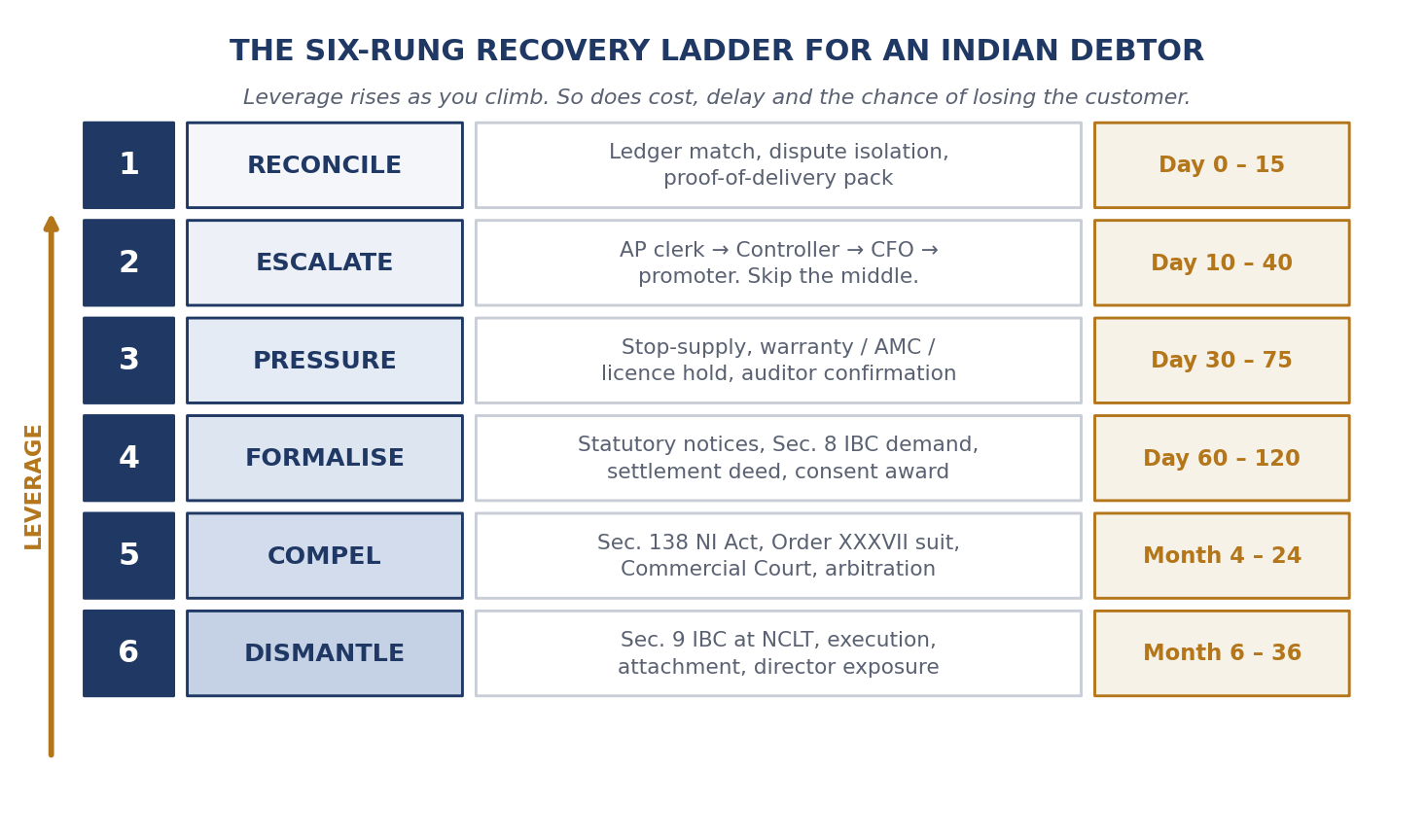
Days 1–10 — establish the number and the identity. Reconcile to a single figure including every credit note, freight deduction, exchange difference and bank charge. Confirm the CIN, PAN and GSTIN, and confirm you invoiced that entity. Pull MCA master data and the charge index.
Days 10–20 — classify. Run the five archetypes. Run the half-day intelligence file: MCA status, charges, GST filing history, EPFO trend, rating search, eCourts name search. Decide whether this is a paying-but-slow account, a distressed one, or a gone one.
Days 20–35 — get the acknowledgement. Whatever else happens, obtain a written confirmation of the balance. A reconciliation call that ends in a signed statement of account does three jobs at once: it may start a fresh limitation period if Section 18 is satisfied, it destroys the pre-existing-dispute defence, and it removes the debtor's ability to invent a quantum argument later. For that limitation effect, the acknowledgement must recognise the relevant liability in writing and be signed before expiry by the liable party or its duly authorised agent; any fresh period runs from signing.
Days 35–50 — escalate by name. To a director identified from MCA records, at the registered office as filed, with a copy to the operating contact. State the amount, the acknowledgement, and a date.
Days 50–70 — apply the commercial lever. Spares, warranty, licence, support, certification, new-order release. One lever, applied properly, with a written explanation of what will restore it.
Days 70–90 — formalise. Either a settlement into an enforceable instrument (a decree in terms of settlement, a consent award, or a mediated settlement agreement under the Mediation Act, 2023 — never a settlement letter), or a statutory step.
Section IV · Choosing the legal route
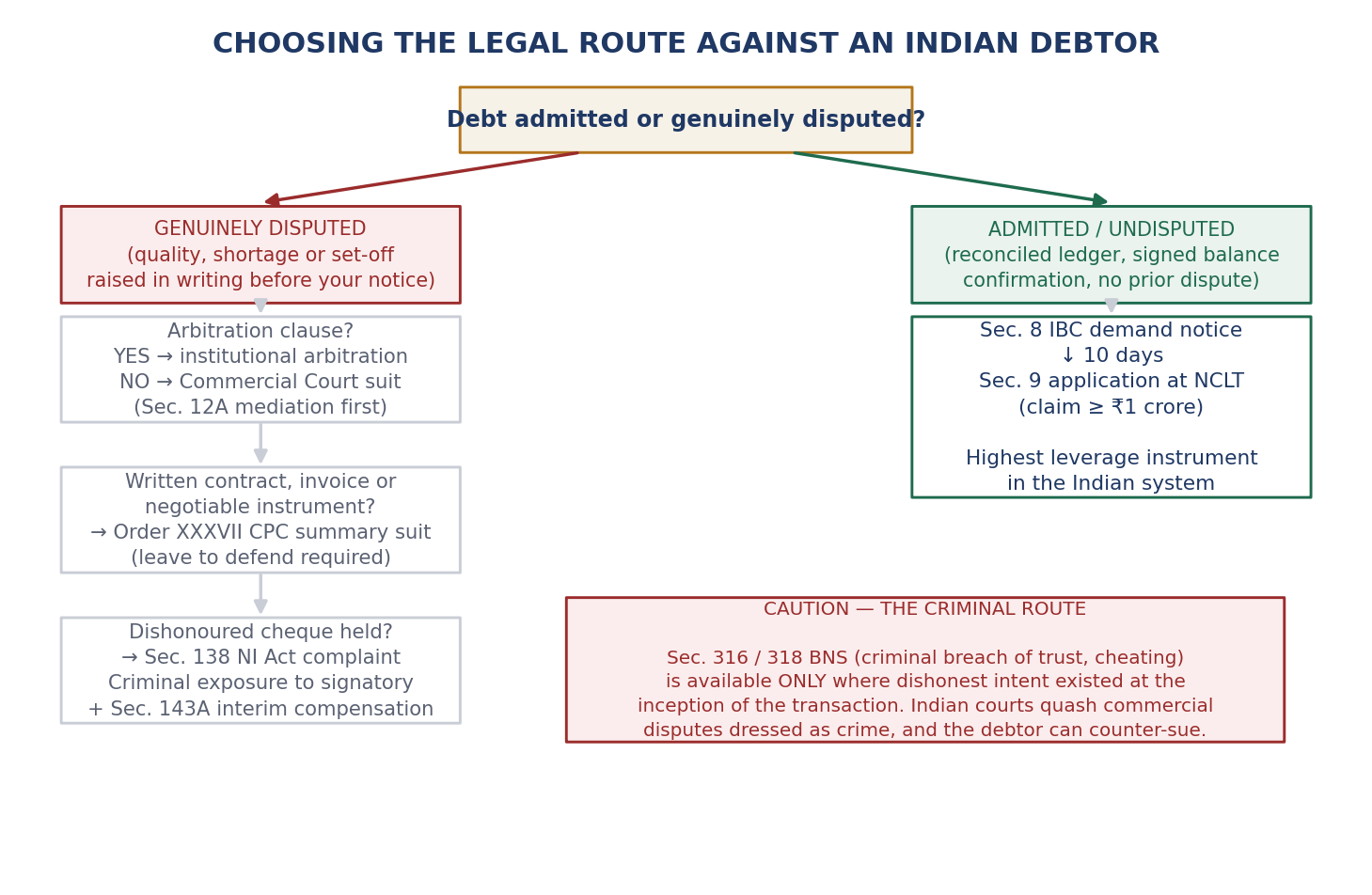
Two questions decide it: is the debt genuinely disputed, and is it ₹1 crore or more.
| If | Then |
|---|---|
| Undisputed, ≥ ₹1 crore | Serve a Section 8 demand notice under the IBC, then file the debt information with an Information Utility (now a precondition under Section 215) before any Section 9 application. The ten days after the Section 8 notice are the most decisive window in the Indian system. See the caution below. |
| Undisputed, below ₹1 crore, written contract or invoice terms | Order XXXVII CPC summary suit. The defendant must seek leave to defend and gets it only on a triable issue. Conditional leave — deposit as a condition of defending — settles a large share of these. |
| Disputed, arbitration clause exists | Institutional arbitration, plus a Section 9 application to an Indian court for interim attachment |
| Disputed, no arbitration clause | Commercial Court, preceded by mandatory pre-institution mediation under Section 12A of the Commercial Courts Act, 2015 unless urgent interim relief is sought. The Supreme Court held Section 12A mandatory in Patil Automation (2022). |
| You hold a dishonoured Indian cheque | Section 138 NI Act complaint, on the strict notice timetable, with Section 143A interim compensation of up to 20 per cent available during trial |
| You already hold a US judgment | Fresh suit in India on the judgment under Section 13 CPC. Slow and expensive — see Section V.1 |
| You already hold a US or foreign arbitral award | Enforcement application to the appropriate Indian High Court under Sections 47–49. Deemed a decree; only Section 48 grounds available |
What changed in April 2026, and why it makes the notice stronger. The Insolvency and Bankruptcy Code (Amendment) Act, 2026 (Act No. 6 of 2026, assented 6 April 2026) replaced "may" with "shall" in Sections 7, 9 and 10, with an express Explanation that no ground other than the three specified ones — default established, application complete, no disciplinary proceedings against the proposed resolution professional — can justify rejection. The discretion recognised in Vidarbha Industries Power Ltd v. Axis Bank (2022) is gone. The fourteen-day decision clock is reinforced, with written reasons required for any delay.
Three consequences for a US creditor:
- New precondition. Under the amended Section 215, an operational creditor must file the financial information with an Information Utility before making a Section 9 application. The debtor must authenticate or dispute it, and silence counts as deemed authentication. Build this step into your timetable — and note that an unrebutted Information Utility record is now among the strongest evidence of default you can hold.
- The Mobilox defence survives. The pre-existing dispute test is unchanged. Everything in Archetype 1 still applies, and it is now the only substantial obstacle between a well-prepared operational creditor and admission — which makes the signed reconciliation more valuable, not less.
- New Section 64A penalises frivolous applications. Filing an IBC application you do not intend to pursue, against a debt you know to be disputed, is no longer cost-free.
Serve the Section 8 notice with real intent and real preparation. File only when you have accepted that a very poor recovery is better than nothing.
Section V · Machinery specific to the US–India corridor
V.1 If you must litigate in the United States
Sometimes you have no choice: no arbitration clause, US-law contract, and a co-defendant in the US.
Service on the Indian defendant. India is a party to the Hague Service Convention and has objected to Article 10, so service by mail, by courier, or through a private process server into India is not valid. Requests must go through the Central Authority — the Ministry of Law and Justice, Department of Legal Affairs, New Delhi — and be routed to the local court. Budget six to eighteen months. File the request the week you issue.
Do not take a bare default. A clerk-entered default judgment is the weakest possible instrument to bring to India, because Section 13(b) CPC — "not given on the merits" — and Section 13(d) — breach of natural justice — are exactly what an ex-parte judgment invites. If you are going to end up in India anyway, obtain a judgment where the court records that it considered evidence, and keep the Hague certificate of service.
Then expect a fresh suit. The Indian action is a suit upon the foreign judgment. Section 14 CPC gives you a presumption of the foreign court's competence, which the defendant must rebut. Limitation is three years from the date of the US judgment.
V.2 Section 1782 discovery — and its real limits
28 U.S.C. § 1782 allows a US district court to order discovery from a person found in its district for use in a proceeding before a foreign or international tribunal. Where an Indian court proceeding is contemplated or pending, this can be extremely useful — for example, to obtain documents or testimony from a US affiliate, a US bank, or a US agent of the Indian group.
But note ZF Automotive US, Inc. v. Luxshare, Ltd. (2022): the Supreme Court held that § 1782 does not extend to private commercial arbitration panels. If your dispute resolution clause points at SIAC or the ICC, § 1782 is not available in aid of it. This is a genuine and often-overlooked cost of choosing arbitration, and it should be weighed — not against the enforcement advantage, which is decisive, but in planning your evidence strategy.
V.3 Compliance discipline in recovery
Recovery activity in India creates compliance exposure for a US company that does not exist at home.
- Foreign Corrupt Practices Act. Any facilitation payment, to any official, by any agent acting for you, is your problem. Instruct your Indian representative in writing that no payment of any kind is to be made to any government official, court official, police officer or bank official, and take a written acknowledgement.
- Agent selection. Recovery "agents" operating by intimidation exist in this market. Engaging one imports criminal exposure under Indian law and manufactures a disclosure event under your own compliance programme. Retain firms that operate on documented process and that can show you their escalation protocol.
- Sanctions and export-control screening. Screen the Indian counterparty and its directors against OFAC lists and the BIS Entity List before shipping and again before settling. A settlement negotiated with a listed party is not a settlement.
- Data protection. Indian personal data is governed by the Digital Personal Data Protection Act, 2023. Anyone offering you a debtor's bank statements, telephone records or tax filings is offering you unlawfully obtained data that is inadmissible and that creates liability on both sides.
V.4 When the buyer is the Indian arm of a US or global group
Do not assume group support. An Indian subsidiary is a separate legal person, a parent comfort letter is not a guarantee, and Indian management of a foreign-owned subsidiary frequently has payment authority constrained by a group treasury process that nobody explained to you. The productive move is lateral: identify the group's US or European treasury or procurement function and escalate there, where your commercial relationship has weight, rather than pushing harder on an Indian finance manager who has no authority to release the payment.
Section VI · What this costs and how long it takes
Planning figures. Confirm with Indian counsel for a specific matter.
| Step | Elapsed time | Cost profile |
|---|---|---|
| Diagnostic and intelligence file | 1 week | Low; largely public sources |
| Structured commercial recovery | 30 – 180 days | Typically success-fee based |
| Section 12A pre-institution mediation | 3 – 5 months (statutory, extendable by 2) | ₹1,000 application fee paid by the applicant; separate ₹15,000–₹75,000 total mediation fee under Schedule II, shared equally by the parties |
| Section 8 IBC notice to settlement | Often under 60 days | Low |
| Section 138 NI Act complaint | Settles early; 1 – 3 years to judgment | Moderate |
| Order XXXVII summary suit | 1 – 3 years | Ad valorem court fee (State-specific) + counsel |
| Commercial Court, contested | 2 – 5 years | Higher; costs recoverable under the amended Sec. 35 CPC |
| SIAC arbitration to award | 12 – 24 months | Institution + tribunal + counsel |
| Enforcement of a foreign award in India | 1 – 3 years including execution | Moderate |
| Fresh suit on a US judgment (Sec. 13 CPC) | 3 – 7 years | High — design your way out of this |
Section VII · Questions US credit managers ask
Can we sue an Indian company without having any presence in India?
Yes. A foreign company can sue in India without registration there. You will need a properly executed power of attorney in favour of Indian counsel, notarised and — for the United States — apostilled under the Hague Apostille Convention. The court may in some circumstances order security for costs.
Our contract says New York law and New York courts. How bad is that?
The governing-law choice is fine and will generally be respected. The forum choice is the problem: a New York judgment requires a fresh Indian suit under Section 13 CPC. If the contract is still open for amendment, the highest-value change you can make is to replace the forum clause with an arbitration clause.
We have an ICDR award from an arbitration seated in New York. Will India enforce it?
Yes. The United States is notified for the purposes of India's New York Convention reservations. The award is enforced by application to the appropriate Indian High Court under Sections 47 to 49 of the Arbitration and Conciliation Act, and on recognition it is deemed a decree of that court. Only the narrow Section 48 grounds are available to resist it. Limitation is three years.
Is there a minimum amount to file at the NCLT?
₹1 crore, since the notification of 24 March 2020, and it applies to each operational creditor individually — separate creditors cannot combine debts to cross it. Since the 2026 amendments you must also file the debt information with an Information Utility before making the application.
How long do we have before the claim expires?
Many Indian trade-debt claims have a three-year period, but the applicable cause of action and dates must be checked. A qualifying acknowledgement must recognise the relevant liability in writing and be signed before the applicable period expires by the liable party or its duly authorised agent. A fresh period under Section 18 runs from signing. For Section 19, payment must be made before expiry by the liable party or its duly authorised agent, with acknowledgement of that payment in the payer’s handwriting or in writing signed by the payer. A fresh period runs from payment. See the statutory conditions in Part 2 of the India recovery guide. Three years from the date of a foreign judgment to sue upon it. Three years to enforce a foreign award.
The buyer is deducting Indian tax from our invoices. Can they do that?
On a pure sale of goods, generally no. On services, software, royalty or a bundled supply with a service element, often yes — and the buyer is personally liable if it under-deducts, which is why it deducts defensively. Supply a Tax Residency Certificate, Form 10F and a no-PE declaration, unbundle your invoicing, and require the buyer to give you Form 16A so you can claim credit.
Our distributor has been struck off the register. Is the debt gone?
No. A company struck off can be restored to the register on an application to the NCLT so that proceedings can be brought against it. Check the strike-off date, check whether the same directors are trading through another entity, and act promptly.
Should we send a legal notice from a US law firm?
It has almost no effect. A demand on Indian letterhead, citing the Indian statutory route that will be used, addressed to a named director at the registered office as filed with the Ministry of Corporate Affairs, is a different document to receive.
Does trade credit insurance change our approach?
It changes your timetable. Almost every policy requires notification of an overdue within a defined window and prohibits granting extensions or agreeing settlements without the insurer's consent. Cover in this corridor is lost far more often through late notification than through anything the debtor does. Read the notification clause the day the account goes past due, not the day you decide to claim.
What this guide cannot tell you
This guide gives you five archetypes. It cannot tell you which one you have — and running the wrong play makes three of the five worse.
- Which archetype is this? A quality hold, a regulatory freeze, a withholding short-pay, a cash-crunch rollover and a vanishing distributor look identical from Ohio. They require opposite responses.
- Is the short payment a dispute or a tax deduction? If it is Section 195 withholding it belongs with your tax people and is largely recoverable. If it is a deduction dressed as one, it is a collection matter. Telling them apart requires the invoices and the treaty position.
- Is the payment stuck at the buyer's bank? A remittance blocked at the authorised dealer bank on a Bill of Entry mismatch is fixable in a week. It is invisible from your side and no demand letter will move it.
- Has a complaint already closed off the insolvency route? Every quality email your buyer sent before your demand is a potential defence. It has to be found in your own file and assessed.
- Where have the directors moved the trade? If the company has gone quiet, the same directors are frequently importing through a different entity. That is public, traceable, and it changes the case entirely.
- Is a US judgment worth pursuing here at all? Sometimes yes, usually no. The answer depends on your contract, your co-defendants and whether the debtor has anything reachable outside India.
The Indian Debtor Recovery Position Report
Those questions have answers. They are specific to your debtor, your documents and your dates, and none of them can be found in a guide.
The Indian Debtor Recovery Position Report is a fixed-fee written assessment of your particular debtor and the routes actually open to you.
| What it contains | The verified legal identity and current standing of the debtor · its financial position, registered charges, litigation history and compliance filings · why the money is stuck — the status of the underlying project or contract, whether the debtor is itself waiting on a government department or a main contractor, the effect of any change of administration or management, and our assessment of whether this is an inability to pay or an unwillingness to pay · whether a pre-existing dispute exists in your own file and what it closes off · the limitation position on your facts and dates · the routes open to you, ranked, with indicative cost, timeline and realistic recovery for each · what we would do first |
| What we need from you | The contract or purchase order, the invoices in dispute, a full statement of account, transport and delivery documents, all correspondence including every complaint and debit note, any acknowledgement or part payment, and your insurance position |
| Coverage | Detailed reporting is available for companies and LLPs, which file publicly in India. For proprietorships and partnership firms the public and government record is thin — we will still make the enquiry, and we will tell you plainly what could and could not be established. |
| Turnaround | 7 to 10 working days from receipt of a complete file |
| Fee | Fixed, and quoted before we begin. The report is chargeable in every case. Where you go on to instruct us and we recover, the fee is credited against the success fee actually earned. |
| Additional work | Anything beyond the scope of the report — further enquiry, additional debtors, field verification — is quoted separately before it is done. |
| If you instruct us to recover | We work on a success fee. The debtor pays you directly — client money never enters our account. |
GGA India Private Limited · Corporate Office — 294, Phase 4, Gurugram, Haryana – 122016 · gg@ggaindia.co.in · ggaindia.com
Annex · The US exporter's India file
Assemble before instructing anyone:
- Contract, purchase order or accepted proforma, with the full email chain
- All invoices and packing lists in dispute, plus the full statement of account from the first transaction
- Transport documents and, where obtainable, the Bill of Entry number and date — the single strongest document against an Indian buyer, because the buyer filed it under its own IEC and it proves clearance and delivery inside India
- Certificate of origin, inspection and test certificates
- Every acknowledgement, balance confirmation, part-payment advice and reconciliation
- Every complaint, debit note and credit note in date order, including the ones that hurt your case — you need to know what a Mobilox dispute defence would look like before your opponent builds it
- Correspondence export accompanied by a certificate under Section 63 of the Bharatiya Sakshya Adhiniyam, 2023 (successor to Section 65B of the Evidence Act), obtained at the time of export, not later
- Counterparty pack: CIN, PAN, GSTIN, registered office, director list with DINs, charge index
- Trade credit policy number and notification history
- Notarised and apostilled board resolution and power of attorney for Indian counsel
Companion guides: the reverse direction is covered in "Collecting US Receivables for Indian Exporters". Pre-transaction screening is covered in "What to Look For in a Counterparty Before Doing Cross-Border Sales". Full statutory mechanics are in the pillar reference, "Recovering B2B Debt from an Indian Company".
This guide is a commercial and procedural reference for credit, collections and risk professionals. It is not legal advice. Statutory thresholds, notified territories and treaty positions change; verify current positions before acting.
Have a live cross-border receivable?
Share the creditor and debtor countries, unpaid value, ageing and available evidence so GGA can review the scope and next step. GGA takes cross-border cases from USD 20,000. Fees are agreed before recovery begins; a Recovery Position Report is optional and is not required to place a claim.