What to Look For in a Counterparty Before You Sell Across a Border
General information, not legal or financial advice. Terms of Use.
On this page
- The premise
- Part One · The nine layers
- Layer 1 — Existence
- Layer 2 — Identity
- Layer 3 — Control
- Layer 4 — Capacity
- Layer 5 — Behaviour
- Layer 6 — Encumbrance
- Layer 7 — Litigation
- Layer 8 — Trade reality
- Layer 9 — Recoverability
- Part Two · The fifteen red flags
- Part Three · Turning the screen into a decision
- The scoring model
- Score to terms
- After onboarding
- Part Four · The five questions to ask the…
- Part Five · What screening cannot tell you
- Frequently asked
- What this guide cannot tell you
A screening protocol for exporters, credit managers and underwriters — with the registries, the red flags, and a scoring model you can run in a day
The premise
Nearly every bad debt was avoidable at onboarding, and almost none of them were avoidable at day 90.
The economics are not close. A full screen on a new counterparty costs a few hours of an analyst's time and, in most jurisdictions, under two hundred dollars in registry fees. A bad debt costs the invoice, the margin on every good sale you needed to make to replace it, the recovery fee, and eighteen months of somebody's attention. Yet most exporters run a credit reference and a bureau score, and skip everything else — because the bureau report arrives as a single number and feels like an answer.
A bureau score tells you what a counterparty's lenders have experienced. It does not tell you whether the entity on your purchase order is the entity on your invoice, who decides whether you get paid, what you could reach if it defaults, or whether the business is still trading.
This protocol has nine layers. Each answers a different question. The loss almost always comes from the layer that was skipped.
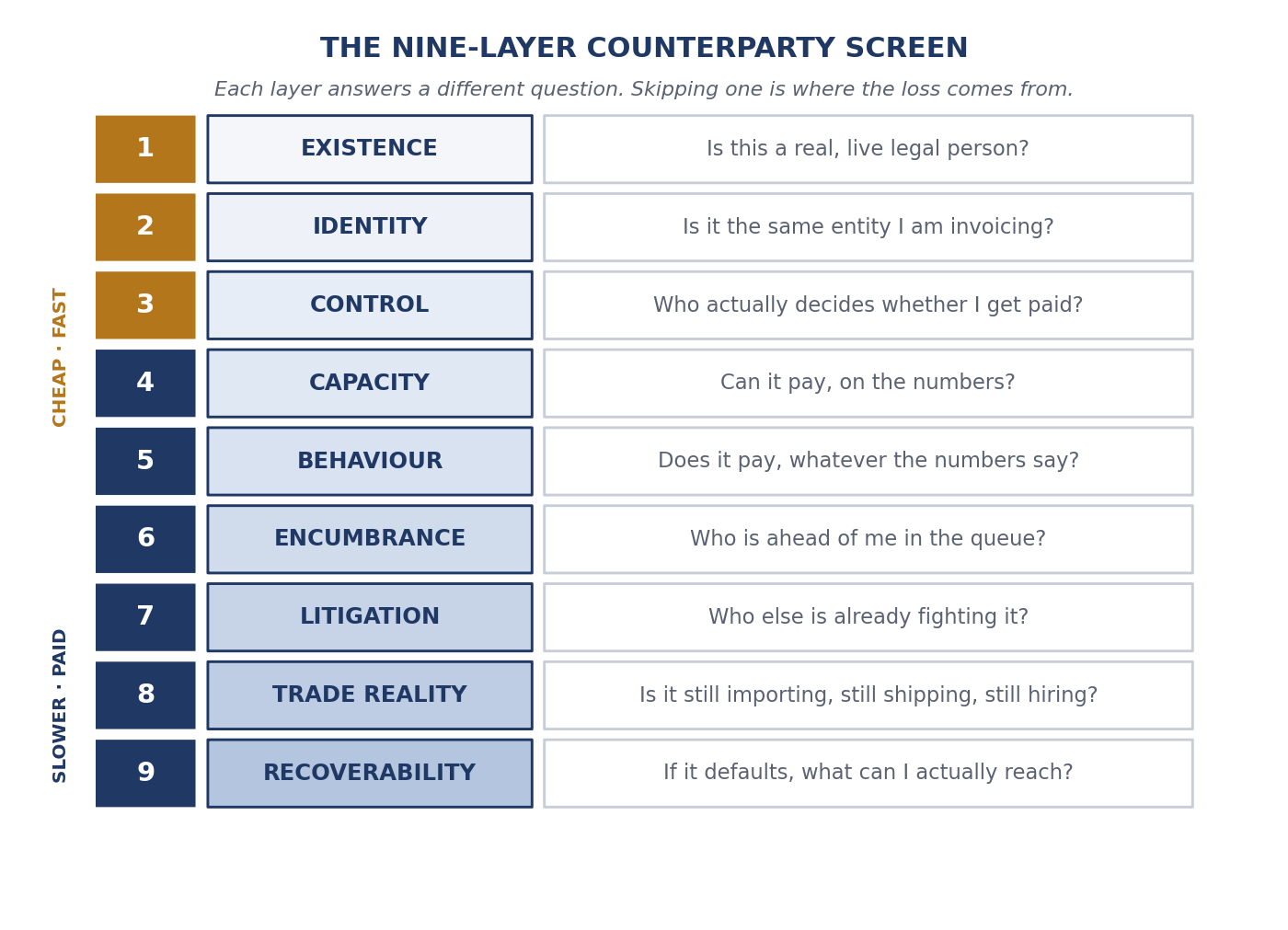
Part One · The nine layers
Layer 1 — Existence
The question: is this a real, live, legal person?
Obtain the counterparty's registration number from the counterparty itself and verify it independently on the register of its own country. Never work from a name — names are not unique in most jurisdictions and are deliberately duplicated in some.
| Country | Register | What is free |
|---|---|---|
| India | Ministry of Corporate Affairs, mca.gov.in — CIN or LLPIN | Master data, status, directors, index of charges |
| United Kingdom | Companies House | Everything, including full filed accounts and filing history |
| United States | Secretary of State of the state of incorporation. There is no federal company register. | Entity status and good standing, usually free |
| Germany | Handelsregister / Unternehmensregister — HRB number; accounts via Bundesanzeiger | Registry extract for a small fee |
| Italy | Registro delle Imprese, through InfoCamere / the local Camera di Commercio — REA number | Visura for a fee |
| Netherlands | Kamer van Koophandel — KvK number | Basic data free |
| Belgium | Kruispuntbank van Ondernemingen / Banque-Carrefour des Entreprises; accounts at the National Bank | Free |
| France | Registre National des Entreprises (INPI) and Infogreffe; insolvency notices in BODACC | Largely free |
| Spain | Registro Mercantil | Fee-based |
| Switzerland | Zefix; official notices in SHAB/FOSC | Free |
| Singapore | ACRA BizFile — UEN | Basic search free; profiles paid |
| UAE | No consolidated federal register. Emirate Departments of Economic Development for onshore trade licences; each free zone runs its own register — DMCC, JAFZA, DAFZA, RAKEZ, SAIF; DIFC and ADGM have their own registrars. | Trade licence verification varies |
| Saudi Arabia | Ministry of Commerce — Commercial Registration (CR) number | Verification available |
| Turkey | MERSIS; Türkiye Ticaret Sicili Gazetesi | Largely free |
| China | National Enterprise Credit Information Publicity System (GSXT) — 18-digit Unified Social Credit Code | Free |
| Hong Kong | Companies Registry (ICRIS) | Search paid, cheap |
| Japan | National Tax Agency corporate number (hōjin bangō); commercial reports from Teikoku Databank or Tokyo Shoko Research | Number lookup free |
| South Korea | DART for listed and reporting entities; NICE and KED for commercial reports | DART free |
| Australia | ASIC Connect — ACN/ABN | Basic free |
Red flag: the counterparty cannot or will not give you its registration number.
Layer 2 — Identity
The question: is the entity I am checking the entity I am invoicing?
This is the layer that catches the most money and gets skipped the most often.
Reconcile, to one legal person: the name on the purchase order, the name on your invoice, the name on the sales contract, the registered name on the register, the name on the bank account you are asked to pay into or that pays you, and the consignee on the transport documents. In India, cross-check the CIN, the PAN, and the GSTIN — the PAN is embedded in the GSTIN, so a mismatch between the two proves you are dealing with two entities. In the EU, cross-check the VAT number through VIES. In China, the Unified Social Credit Code appears on the chop and on the register.
Two specific traps:
- The near-name group. Mid-market groups in India, China, Turkey and the Gulf routinely run several entities with near-identical names, shared premises and shared letterhead. Your order arrived from one, your goods went to another, and the payment was promised by a third — and the one you invoiced is the one with no assets.
- The third-country bank account. A mainland Chinese seller asking to be paid to a Hong Kong account, or an Indian buyer paying you from a UAE account, may have entirely legitimate reasons. It may also mean your commercial recourse is against an entity in a jurisdiction you have not assessed, and it raises sanctions-screening obligations you need to discharge. Ask the reason and document the answer.
Layer 3 — Control
The question: who actually decides whether I get paid?
In a promoter-led or family-owned business — which is most of the mid-market in India, the Gulf, Turkey, Italy and much of Asia — the payment decision is made by one person, and it is not the person emailing you. Establish who that is before you need to reach them.
- Directors, managing directors, and their other directorships. In India, MCA director search by DIN reveals every other company the same person runs — the fastest route to where the money went, later.
- Ultimate beneficial ownership where a register exists.
- In China specifically: identify the legal representative (法定代表人) and understand that the company chop binds the company. A contract bearing the chop is binding; a contract bearing only a signature may not be.
- In the Gulf, understand the local sponsorship or ownership structure and whether the entity you are contracting with is the licensed trading entity.
Layer 4 — Capacity
The question: can it pay, on the numbers?
Where filed accounts exist, read them — do not just take the score derived from them.
- Filing currency. Late-filed or unfiled accounts are the signal, before you read a line of them.
- Trade payables against cost of sales — implied days payable outstanding. Rising DPO is a company financing itself off its suppliers. You are about to become one.
- Short-term borrowings against total borrowings. A working-capital book funded almost entirely on short-term revolving lines is fragile.
- Contingent liabilities and guarantees given — group guarantees can consume the balance sheet you are relying on.
- The auditor's report. A qualification, an emphasis of matter on going concern, or a mid-term auditor resignation is worth more than any ratio.
- Where accounts are not public — the United States, much of the Gulf, private companies in several jurisdictions — you are dependent on the counterparty giving them to you, on a commercial report, or on trade references. Ask for them. Refusal on a material credit line is itself information.
Layer 5 — Behaviour
The question: does it pay, whatever the numbers say?
Capacity and behaviour are different things, and behaviour predicts better. A profitable company with a policy of paying at 120 days will damage you more than a marginal one that pays at 45.
- Commercial credit bureau data. TransUnion CIBIL Commercial and the CIBIL MSME Rank in India; Experian, Equifax, CRIF High Mark; Dun & Bradstreet internationally; Creditsafe, Coface, Allianz Trade and Atradius grades in Europe.
- Trade references — asked properly. "Would you sell to them again on the same terms?" is a better question than "do they pay?" Ask for three, and ask for at least one supplier in your own product category and price band.
- The counterparty's own DPO trend from its filed accounts, compared with its sector. This is the most honest behavioural indicator available from public data, and it is available even where no bureau covers the company.
- Payment-behaviour indices and country payment surveys for the base rate in the market.
Layer 6 — Encumbrance
The question: who is ahead of me in the queue?
You are an unsecured creditor. Everyone with a registered security interest ranks ahead of you.
- India: MCA Index of Charges (Forms CHG-1 and CHG-4) and CERSAI
- United States: UCC-1 financing statements at the Secretary of State
- United Kingdom: charges register at Companies House
- Germany, Italy, France, Spain: registered pledges, mortgages, and — in Italy — privilegio speciale
- Most jurisdictions: land and mortgage registers
What to read from it. A recent flurry of new charges, a charge granted to a non-bank lender at what is obviously a high cost of funds, or a charge over receivables specifically, all say the same thing: the counterparty has run out of cheaper money.
Layer 7 — Litigation
The question: who else is already fighting it, and about what?
- India: eCourts services and CNR search, High Court and Supreme Court portals, NCLT and NCLAT order portals, IBBI public announcements
- United States: PACER for federal litigation and bankruptcy; state court portals
- United Kingdom: Register of Judgments, Orders and Fines; Companies House insolvency filings; the Gazette
- China: China Judgments Online, and the Supreme People's Court list of dishonest judgment debtors — a genuinely powerful and free public blacklist
- Europe: BODACC in France, insolvency registers in Germany, national gazettes elsewhere
A pattern of supplier suits is decisive. One dispute with a customer is noise; five suits from suppliers in two years is a payment policy.
Layer 8 — Trade reality
The question: is it still importing, still shipping, still hiring?
Filed accounts are up to eighteen months old. Operating data is current.
- Customs and shipment-level trade data (commercial providers exist for most major markets): is the counterparty still importing, in what volumes, from whom — and has it quietly switched to a competitor after burning them?
- India: GST return-filing history on the GST portal is one of the earliest distress signals available anywhere, because filing lapses precede payment default by months. EPFO contribution data shows the real headcount trend.
- Everywhere: job postings, plant announcements, and the counterparty's own customers.
Layer 9 — Recoverability
The question: if this goes wrong, what can I actually reach — and how?
Ask this before you ship, because the answer changes the contract you sign.
- Is my home country a reciprocating territory for judgment enforcement in the buyer's country, and vice versa? For India, only a short notified list qualifies — the UK, Singapore, the UAE, Hong Kong, Malaysia, New Zealand and a few others. The United States, Germany, Italy, France, Japan and China are not on it.
- Are both countries party to the New York Convention, with the necessary reservations satisfied? If yes — and for almost every significant trading nation it is, though India has not notified the UAE — an arbitration clause converts an unenforceable judgment into an enforceable award. This is the single highest-value item in the whole protocol.
- What assets exist in a jurisdiction I can reach? A trading company with no plant, no land and one bank account is a different risk from a manufacturer with a mortgaged factory.
- Is there a personal guarantee available from the person identified in Layer 3?
Part Two · The fifteen red flags
Patterns, not rules. One of these is a question to ask. Three of these together is a decision.
| # | Pattern | Why it matters |
|---|---|---|
| 1 | The entity on the PO, the invoice and the bank account are not all the same legal person | Your contract, your delivery and your money are attached to different entities. Recourse fails. |
| 2 | Registration number withheld, or given and does not verify | There is no benign explanation. |
| 3 | Registered office is a residence, a virtual office or a shared desk address, for a business claiming volume | Nothing to visit, nothing to attach, and service of process becomes a problem. |
| 4 | Recently incorporated entity places an unusually large first order | The classic set-up. See flag 6. |
| 5 | Directors with a history of struck-off, dissolved or liquidated companies | The pattern repeats. Check each director's other directorships. |
| 6 | Two or three small orders paid perfectly, then a step-change in order size with a request for extended terms | The bust-out. The small orders exist to build a credit file. The large one is the point of the exercise. Treat any order materially larger than the established pattern as a new counterparty requiring a fresh decision. |
| 7 | Bank details changed by email, especially close to a payment date | Business email compromise / payment-diversion fraud. Never act on emailed bank-detail changes. Verify by voice call to a number you already held, not to a number in the email. |
| 8 | Free-zone or offshore entity with no operating substance and an onshore group behind it | Your contract may be with the entity that holds nothing. |
| 9 | Auditor resigned, qualified opinion, going-concern emphasis, or a ratings "Issuer Not Cooperating" tag | The people with the best information stopped signing. |
| 10 | Statutory accounts filed late or not at all | The cheapest and most reliable single indicator of distress. |
| 11 | Recent cluster of registered charges, or a charge specifically over receivables | Cheaper money ran out. Receivables charged to a lender are receivables you cannot reach. |
| 12 | Counterparty insists on nominating the freight forwarder and controlling the transport documents | Cargo can be released without presentation of the original bill of lading. You lose control of the goods before you are paid. |
| 13 | Pressure to ship before documentation is complete, with the paperwork "to follow" | The missing document is usually the one you would have needed. |
| 14 | Reluctance to accept an arbitration clause, or insistence on the courts of its own jurisdiction with no reciprocity | The counterparty, or its lawyer, has thought about enforcement. So should you. |
| 15 | Sudden request to route payment through, or ship to, a third country not previously involved | Sanctions exposure, diversion risk, and a change of recourse jurisdiction all at once. |
Part Three · Turning the screen into a decision
The scoring model
Score each layer 0 to 5, where 5 is clean and 0 is a hard stop. Weight and total.
| Layer | Weight | 5 = clean | 0 = stop |
|---|---|---|---|
| 1 Existence | 5% | Verified on register, active, long-established | Not found, dissolved, or struck off |
| 2 Identity | 15% | One legal person across all documents | Mismatch between contracting party and payer |
| 3 Control | 10% | Decision-maker identified and reachable | Ownership opaque; no reachable principal |
| 4 Capacity | 15% | Current accounts, healthy, clean audit report | No accounts and none offered |
| 5 Behaviour | 20% | Good bureau grade; three positive references; stable DPO | Bureau adverse; supplier judgments; references decline to answer |
| 6 Encumbrance | 10% | Little or no secured debt | Fully charged, including receivables |
| 7 Litigation | 10% | Nothing adverse | Insolvency pending, or a pattern of supplier suits |
| 8 Trade reality | 5% | Trading, importing, hiring | Filings lapsed, headcount falling, imports stopped |
| 9 Recoverability | 10% | Enforceable route + reachable assets + guarantee available | No enforcement route and no attachable assets |
Any layer scoring 0 is a hard stop regardless of total. A high total does not cure a fatal single layer, and this is the most common way a scoring model gets misused.
Worked example
A German machine-tool builder screens a first-time Indian buyer for a €340,000 order.
| Layer | Finding | Score | Weighted |
|---|---|---|---|
| Existence | CIN verified on MCA, incorporated 2011, status Active | 5 | 0.25 |
| Identity | PO from Company A Pvt Ltd; delivery requested to Company B Pvt Ltd at the same address | 2 | 0.30 |
| Control | Two directors, one is clearly the promoter; three other active directorships, all clean | 4 | 0.40 |
| Capacity | AOC-4 filed on time; DPO risen from 68 to 141 days over three years | 3 | 0.45 |
| Behaviour | CMR 5; two references positive, one declined to comment | 3 | 0.60 |
| Encumbrance | Working-capital charge to a public sector bank; a second charge to an NBFC created four months ago | 2 | 0.20 |
| Litigation | Two supplier suits pending in the Commercial Court | 2 | 0.20 |
| Trade reality | GST returns filed current; EPFO headcount stable; still importing components from three EU suppliers | 4 | 0.20 |
| Recoverability | Germany is not a reciprocating territory; no arbitration clause in the draft contract; plant is mortgaged | 1 | 0.10 |
| 2.70 / 5 |
Decision. Not a refusal — a restructure. Nothing here says the buyer will not pay. It says the buyer is stretching its suppliers, has taken expensive second-tier money, is being sued by two of them, and that this seller currently has no enforcement route.
Four changes convert it: contract with the single entity named on the PO with CIN and GSTIN stated; insert an arbitration clause seated in Singapore or Mumbai; take an irrevocable letter of credit confirmed by a European bank for the first two shipments; take the promoter's personal guarantee for the balance. Score after restructuring: 3.9, and the two weakest layers are now covered rather than merely noted.
Score to terms
| Band | Indicative terms |
|---|---|
| 4.3 – 5.0 | Open account at requested terms; standard limit; annual review |
| 3.5 – 4.2 | Open account with a reduced limit, or standby LC over a threshold; half-yearly review |
| 2.6 – 3.4 | Confirmed LC, or documents-against-payment, or prepayment; personal guarantee sought; quarterly review |
| 1.5 – 2.5 | Prepayment or confirmed LC only. No open account at any limit. |
| Below 1.5, or any zero layer | Decline, or trade on cash in advance with no credit exposure at any point |
After onboarding: the monitoring cadence
Screening at onboarding and never again is how good accounts become bad debts. Set a cadence proportionate to exposure.
| Trigger | Action |
|---|---|
| Monthly | Automated register watch: status change, new charge, director change, new insolvency filing |
| Quarterly | Filing-compliance check (in India, GST return status; elsewhere, statutory accounts filing) |
| On every new accounts filing | Re-read the audit report and recompute DPO |
| On any order materially above the established pattern | Full re-screen. Treat it as a new counterparty. Flag 6. |
| On the first missed payment | Immediate Layers 6, 7 and 8 refresh — encumbrance, litigation, trade reality |
| On any request to change bank details | Voice verification on a previously held number. No exceptions, ever. |
| On any change of directors or registered office | Full Layer 3 refresh |
Part Four · The five questions to ask the counterparty directly
Screening is not surveillance. Most of what you need, a legitimate counterparty will simply tell you — and the manner of the answer is itself data.
- "What is your registration number, tax number and registered legal name?" A trading business answers this in one line.
- "Which legal entity will be the contracting party, and is that the entity that will pay?" If the answer has two names in it, you have found Layer 2 before it found you.
- "Can you give us three trade references in our product category?" Ask for the category. Anyone can produce three friendly references from a different price band.
- "Who signs off payment releases, and what is your internal approval route above a certain value?" This is a normal commercial question and the answer gives you Layer 3 for free.
- "Are you comfortable with arbitration seated in [neutral seat]?" How this is answered tells you whether the counterparty has thought about the day it does not pay.
Part Five · What screening cannot tell you
Honesty about the limits keeps the model useful.
- It cannot predict a shock. A currency move, a regulatory ban, a customs reclassification or the loss of the counterparty's own largest customer will not appear in any layer.
- Filed accounts are historical and, in some markets, optimistic. Treat them as one input among nine, not as the answer.
- A clean screen is not security. Screening changes the probability. Only a letter of credit, a guarantee, insurance, or prepayment changes the exposure.
- The best-screened counterparty can still be defrauded, and you with it. Flag 7 — payment-diversion fraud — hits companies with perfect credit. The control for it is a process control, not a credit assessment.
Frequently asked
How long should a full screen take?
A first-time counterparty on a material order: half a day for an analyst who knows the registries, plus the wait for trade references. A repeat counterparty: under an hour.
What does it cost?
In most jurisdictions, under USD 200 in registry and bureau fees. Where filed accounts are not public — the United States, much of the Gulf — add the cost of a commercial report, or ask the counterparty directly.
Is a Dun & Bradstreet report enough on its own?
It covers Layers 4 and 5 well and Layer 1 adequately. It does not tell you whether you are invoicing the right entity, who decides payment, what is charged, who is suing, or what you could enforce. Those are the layers that decide the outcome.
Our counterparty refuses to give financial statements. Is that a decline?
Not automatically — in several jurisdictions private companies genuinely do not prepare them in a shareable form. It shifts weight onto Layers 5, 6, 7 and 8, and onto securing the exposure rather than assessing it.
What is the single highest-value change most exporters could make?
Insert an arbitration clause, seated somewhere neutral, in every cross-border contract. It costs nothing at signature and it is the difference between an enforceable claim and a decorative one.
What this guide cannot tell you
This protocol tells you what to check. It cannot run the check on your counterparty, and it cannot tell you what the answers mean together.
- Does the entity you are about to contract with actually exist as described? Registration number, status, capital, directors and filing history, verified on the register of its own country rather than taken from its letterhead.
- Who is behind it? Corporate shareholders, common directorships, and whether the counterparty is an operating business or a conduit for a group elsewhere.
- What is already charged, and who is ahead of you? Registered security interests, recent charges, and lenders whose cost of funds tells you the counterparty has run out of cheaper money.
- Who is already suing it? Supplier judgments, pending insolvency applications and litigation patterns — public in most jurisdictions and rarely checked.
- What is the score, and what terms does it justify? The nine layers weighted against each other, with a recommended credit limit and payment mechanism rather than a number to interpret yourself.
- If it defaults, what could you actually reach? Assets, jurisdiction, enforcement route and whether a guarantee is available — assessed before you ship, when it can still change the contract.
The Indian Debtor Recovery Position Report
Those questions have answers. They are specific to your debtor, your documents and your dates, and none of them can be found in a guide.
The Indian Debtor Recovery Position Report is a fixed-fee written assessment of your particular debtor and the routes actually open to you.
| What it contains | The verified legal identity and current standing of the debtor · its financial position, registered charges, litigation history and compliance filings · why the money is stuck — the status of the underlying project or contract, whether the debtor is itself waiting on a government department or a main contractor, the effect of any change of administration or management, and our assessment of whether this is an inability to pay or an unwillingness to pay · whether a pre-existing dispute exists in your own file and what it closes off · the limitation position on your facts and dates · the routes open to you, ranked, with indicative cost, timeline and realistic recovery for each · what we would do first |
| What we need from you | The contract or purchase order, the invoices in dispute, a full statement of account, transport and delivery documents, all correspondence including every complaint and debit note, any acknowledgement or part payment, and your insurance position |
| Coverage | Detailed reporting is available for companies and LLPs, which file publicly in India. For proprietorships and partnership firms the public and government record is thin — we will still make the enquiry, and we will tell you plainly what could and could not be established. |
| Turnaround | 7 to 10 working days from receipt of a complete file |
| Fee | Fixed, and quoted before we begin. The report is chargeable in every case. Where you go on to instruct us and we recover, the fee is credited against the success fee actually earned. |
| Additional work | Anything beyond the scope of the report — further enquiry, additional debtors, field verification — is quoted separately before it is done. |
| If you instruct us to recover | We work on a success fee. The debtor pays you directly — client money never enters our account. |
Where your debtor is outside India, the equivalent product is the Foreign Debtor Recovery Position Report, on the same terms.
GGA India Private Limited · Corporate Office — 294, Phase 4, Gurugram, Haryana – 122016 · gg@ggaindia.co.in · ggaindia.com
Corridor-specific screening — which registries, which filings, which local traps — is covered in the country guides. The mechanics of enforcement against an Indian counterparty are in the pillar reference, "Recovering B2B Debt from an Indian Company".
This guide is a commercial reference for credit, collections and risk professionals. It is not legal advice.
Check the counterparty before extending exposure.
Share the relationship, transaction and decision you need to make. GGA can scope the appropriate Customer, Vendor or Dealer Intelligence assessment before you commission work.
Request a counterparty assessment · See executive-summary examples