Collecting US Receivables for Indian Exporters
General information, not legal or financial advice. Terms of Use.
On this page
- Before default · Two decisions that set…
- Day 1 of default · The commercial clock and…
- The bankruptcy clocks — the part Indian…
- Four years · The limitation clock on the debt…
- Choosing the route
- The Indian regulatory side, running in parallel
- Questions Indian exporters ask about US…
- What this guide cannot tell you
- Verification log
A timeline with the clocks marked — because American law gives a supplier real remedies, and every one of them expires on a date
Indian exporters tend to treat a slow US customer the way they treat a slow Indian one: chase, wait, escalate, wait. That instinct is expensive here, because the United States is unusual in giving an unpaid supplier several genuinely valuable statutory remedies — and every one of them is time-barred, most of them by a period measured in days rather than years.
It also has a trap running the other way that shocks Indian sellers: money you have already been paid can be taken back.
This guide is a timeline. Each entry gives the clock, what it does, and what triggers it.
Before default · Two decisions that set everything up
The jurisdiction decision. An Indian court judgment is of very little practical use against a US buyer. There is no reciprocal enforcement treaty; recognition depends on state law, most commonly a version of the Uniform Foreign-Country Money Judgments Recognition Act, and the process is neither quick nor certain.
An Indian arbitral award, by contrast, is enforced in the United States under Chapter 2 of the Federal Arbitration Act, which implements the New York Convention. The limitation for applying to confirm is three years from the date the award is made — 9 U.S.C. § 207. That is a short period and it is not extended by negotiation.
So: arbitrate. An Indian seat under the MCIA, DIAC or IIAC rules is entirely enforceable in the US and materially cheaper than a foreign seat. SIAC in Singapore or the ICDR are the usual neutral compromises. State the seat, the governing law of the contract, and the governing law of the arbitration agreement as three separate things.
The security decision. US law offers something Indian exporters rarely take: a purchase money security interest perfected by filing a UCC-1 financing statement with the Secretary of State of the buyer's jurisdiction. It converts you from an unsecured supplier into a secured creditor with priority in the goods you supplied. It costs very little, it is administrative rather than adversarial, and it changes your position entirely if the buyer fails. Take US advice on the filing requirements and timing, which are strict.
Day 1 of default · The commercial clock and the first check
Reconcile to a single figure. Then check one thing before you spend anything: is the buyer solvent, and is a filing likely?
PACER — the federal courts' electronic records system — shows federal litigation and bankruptcy filings. State court portals show suits. A pattern of supplier suits against your buyer is a payment policy, not a coincidence.
If a filing looks likely, everything in the next section becomes urgent, because the most valuable US remedies are measured backwards from the petition date.
The bankruptcy clocks — the part Indian exporters most often miss
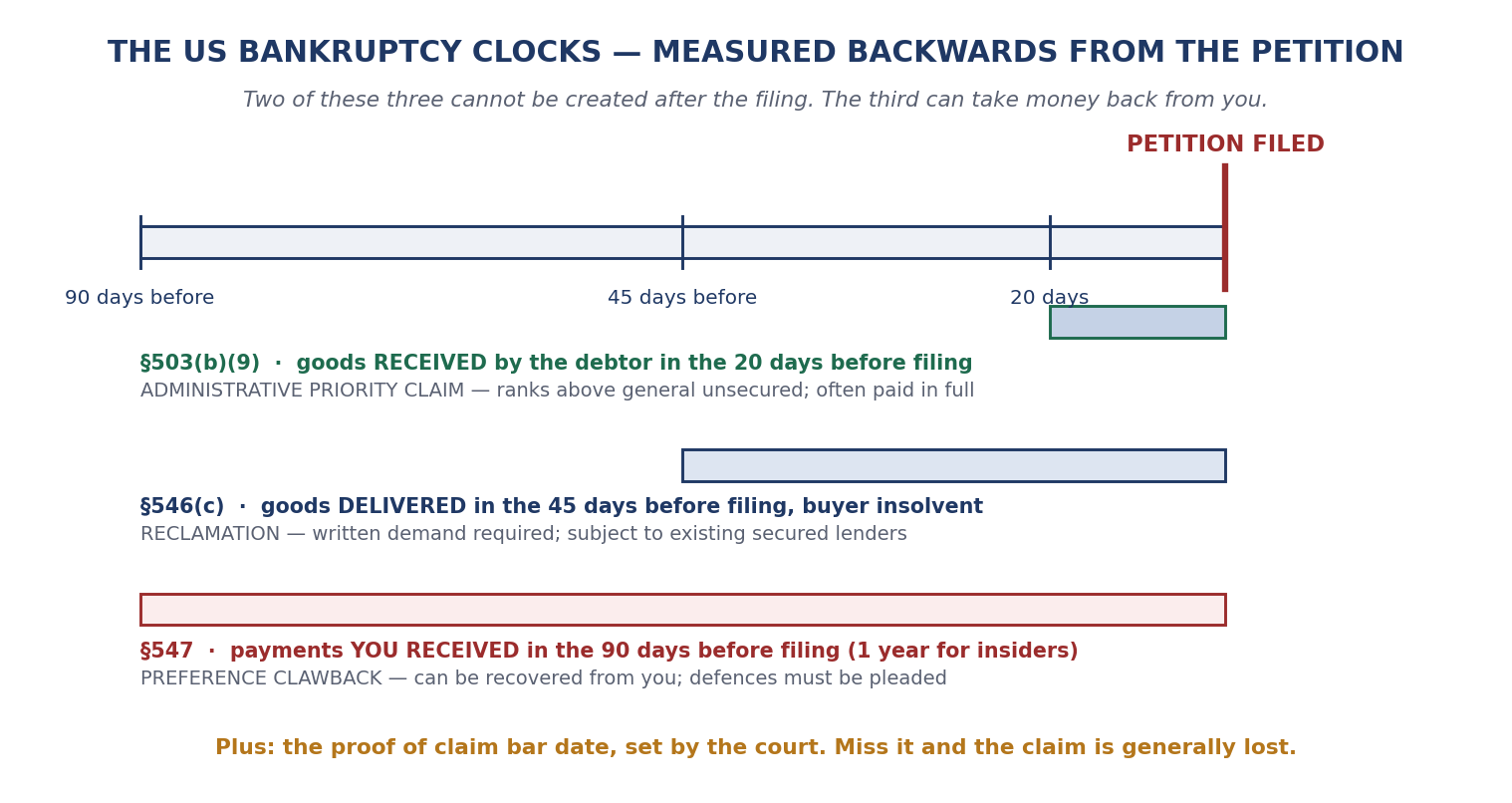
These apply if your buyer files under Chapter 7 or Chapter 11. They are worth understanding before it happens, because two of the three are measured from the filing date backwards and cannot be created afterwards.
| Clock | Provision | What it gives you |
|---|---|---|
| Qualifying goods received by the debtor in the 20 days before the bankruptcy case commenced | 11 U.S.C. §§ 503(a), 503(b)(9) | The value of goods sold to the debtor in the ordinary course of the debtor’s business and received by the debtor within that lookback may qualify for an administrative expense. Keep evidence of receipt, value and ordinary-course sale. Under Section 503(a), make a timely request, or obtain permission to file late for cause; allowance under Section 503(b) is subject to notice and a hearing. The 20 days is a receipt lookback, not a filing deadline. An allowed claim has Section 507(a)(2) priority, but priority does not guarantee payment or any recovery percentage. The provision covers goods, not services. US bankruptcy counsel should confirm eligibility, local procedure, deadlines and receipt issues on the facts. |
| Goods delivered in the 45 days before the petition, while the buyer was insolvent | 11 U.S.C. § 546(c) | A reclamation right — to reclaim the goods themselves. A written demand is required, generally within 45 days of the buyer's receipt of the goods, or within 20 days after the petition if the 45-day period ends after filing. Reclamation is subject to the rights of existing secured lenders, which often defeats it in practice, but the demand costs almost nothing and preserves the position. |
| Payments you received in the 90 days before the petition | 11 U.S.C. § 547 | The trap. These may be recovered from you as preferences — extended to one year for insiders. Defences exist, including the ordinary course of business defence and the subsequent new value defence, but they must be pleaded and evidenced. |
| The proof of claim bar date | Set by the court | Miss it and the claim is generally lost. Watch the notices. |
Four years · The limitation clock on the debt itself
For a contract for the sale of goods, UCC § 2-725 provides a four-year limitation period running from the breach, and it permits the parties to reduce that period by agreement to as little as one year — so check your own contract terms as well as the statute. States vary in their adoption and in their treatment of contracts that are not sales of goods, and a written acknowledgement of the debt may restart the period in some states and not others.
Do not assume you have the six years you would have in England, or the three years you have in India. Establish the applicable state's position early.
Choosing the route
| Situation | Route |
|---|---|
| Buyer solvent, debt undisputed, relationship worth keeping | Structured collection through a US-licensed agency or your own escalation. Note that many US states license commercial collection activity; the Fair Debt Collection Practices Act is a consumer statute and does not apply to B2B debt, but state licensing rules may still apply to whoever acts for you. |
| Buyer solvent, debt disputed, arbitration clause exists | Arbitration, then confirmation of the award in the US District Court under Chapter 2 of the FAA within three years |
| Buyer solvent, no arbitration clause | US state or federal court proceedings. Assess where jurisdiction lies, and whether prejudgment attachment is available in that state — the standard is high and it varies, but where available it is decisive. |
| Buyer failing, filing likely | The bankruptcy clocks above. Act on days, not months. |
| Buyer has filed | Proof of claim by the bar date; a §503(b)(9) request if eligible, within the applicable request deadline (or with court permission to file late for cause); watch for a preference demand coming back at you |
| You need evidence held in the US for an Indian proceeding | 28 U.S.C. § 1782 — a US District Court may order discovery from a person found in its district for use in a foreign tribunal. Note the limit: in ZF Automotive US, Inc. v. Luxshare, Ltd. (2022) the Supreme Court held § 1782 does not extend to private commercial arbitration panels. It is available in aid of court proceedings, not in aid of your SIAC or ICC arbitration. |
The Indian regulatory side, running in parallel
A US recovery does not exist in isolation. While the commercial process runs, the regulatory one does too, and it has its own consequences.
- EDPMS. The shipping bill remains open until realised or closed. Reconcile monthly.
- From 1 October 2026, the ordinary realisation period is nine months, or twelve months where the export is invoiced or settled in Indian rupees. Goods run from shipment, services from invoice, and overseas-warehouse goods from sale. Project exports follow contractual payment terms. Ask the AD bank to confirm the applicable date and any extension.
- Under Regulation 13, if proceeds remain unrealised for more than one year after the realisation due date or the extended period allowed by the AD bank, further exports must be against full advance payment or an irrevocable letter of credit. Existing caution-list orders at 30 September 2026 continue until removal.
- Insurance. Declare the overdue bill to ECGC by the 15th of the following month, or within your private insurer's window, and do not grant an extension or agree a settlement without the insurer's prior written consent. Payment of a claim by ECGC or an IRDAI-regulated insurer is itself a specifically provided route to closing the bill.
- Closure. The 2026 framework has applied since 1 October 2026. Ask the AD bank to handle reduction, set-off and EDPMS closure with supporting evidence. An exporter declaration for a qualifying small bill is not independent authority to close the bank’s EDPMS entry.
The full lifecycle is in Indian Exporters Selling to Overseas Buyers.
Questions Indian exporters ask about US receivables
Can we enforce an Indian court judgment against a US buyer?
Only with difficulty. There is no treaty; recognition depends on state law and is neither quick nor certain. An Indian arbitral award, by contrast, is enforced under Chapter 2 of the Federal Arbitration Act — confirm it within three years under 9 U.S.C. § 207.
Our customer filed for Chapter 11 last month. Is anything worth doing?
Yes, urgently. Check Section 503(b)(9) eligibility: goods must have been sold to the debtor in the ordinary course of its business and received by it within the 20 days before the case commenced. Prove receipt and value, make a timely Section 503(a) request (or obtain permission to file late for cause), and obtain allowance. The 20-day lookback is not a request deadline; priority does not guarantee recovery. Check whether goods were delivered in the 45 days before filing and whether a reclamation demand is still available. And file the proof of claim before the bar date.
They are asking us to return payments we received before the filing. Can they do that?
Sometimes. Under § 547, payments received in the 90 days before the petition — one year for insiders — may be recovered as preferences. There are defences, principally ordinary course of business and subsequent new value, but they must be pleaded with evidence. Take US advice; do not simply pay.
How long do we have to sue on the debt?
For a sale of goods, generally four years under UCC § 2-725, but the parties may reduce it by agreement and state positions vary. Establish the applicable state's rule early rather than assuming an Indian or English period.
Can we use § 1782 to get documents for our arbitration?
No. ZF Automotive (2022) held that § 1782 does not reach private commercial arbitration panels. It is available in aid of foreign court proceedings.
Do US debt collection rules restrict what our agency can do?
The FDCPA is a consumer statute and does not apply to business-to-business debt. State licensing of commercial collection activity may still apply, so check that whoever acts for you is properly licensed in the relevant state.
Should we file a UCC-1?
Where you supply goods on credit to a US buyer, a properly perfected purchase money security interest converts you from an unsecured supplier into a secured creditor in those goods. The filing requirements and timing are strict. It is one of the highest-return administrative steps available in this corridor and almost no Indian exporter takes it.
What this guide cannot tell you
This guide marks the clocks. It cannot tell you which ones are still running on your file — and two of them cannot be restarted once missed.
- Is a filing coming, and how much time do you have? Court records show it before the buyer does. The 20-day and 45-day windows are measured backwards from a date you may not yet know.
- What did the buyer receive, and exactly when? For Section 503(b)(9), check receipt within the 20-day lookback, value, sale in the ordinary course of the debtor’s business, and the request and allowance requirements. Preserve the delivery and sale records; US bankruptcy counsel should assess receipt for the actual shipment.
- Are you exposed to a clawback? Payments you already banked may be recoverable. Whether a defence is available depends on your payment history and what you supplied afterwards.
- What is the limitation position in that State? Four years is the general rule for sale of goods, but it varies, and your own contract may have shortened it.
- Is your award or judgment route open? An Indian award enforces in the US within three years. An Indian judgment mostly does not. Which you have, and how long is left, decides the strategy.
- What is the buyer's real position? Litigation, filings, secured lenders and whether other suppliers are already suing.
The Foreign Debtor Recovery Position Report
Those questions have answers. They are specific to your debtor, your documents and your dates, and none of them can be found in a guide.
The Foreign Debtor Recovery Position Report is a fixed-fee written assessment of your particular debtor and the routes actually open to you.
| What it contains | The verified legal identity and current standing of the debtor · its financial position, registered charges, litigation history and compliance filings · why the money is stuck — the status of the underlying project or contract, whether the debtor is itself waiting on a government department or a main contractor, the effect of any change of administration or management, and our assessment of whether this is an inability to pay or an unwillingness to pay · whether a pre-existing dispute exists in your own file and what it closes off · the limitation position on your facts and dates · the routes open to you, ranked, with indicative cost, timeline and realistic recovery for each · what we would do first |
| What we need from you | The contract or purchase order, the invoices in dispute, a full statement of account, transport and delivery documents, all correspondence including every complaint and debit note, any acknowledgement or part payment, and your insurance position |
| Coverage | Depth varies by the debtor's jurisdiction and legal form. Incorporated entities are documented in most markets; sole traders and partnerships far less so — we will still make the enquiry, and we will tell you plainly what could and could not be established. |
| Turnaround | 7 to 10 working days from receipt of a complete file |
| Fee | Fixed, and quoted before we begin. The report is chargeable in every case. Where you go on to instruct us and we recover, the fee is credited against the success fee actually earned. |
| Additional work | Anything beyond the scope of the report — further enquiry, additional debtors, field verification — is quoted separately before it is done. |
| If you instruct us to recover | We work on a success fee. The debtor pays you directly — client money never enters our account. |
GGA India Private Limited · Corporate Office — 294, Phase 4, Gurugram, Haryana – 122016 · gg@ggaindia.co.in · ggaindia.com
Verification log
| Item | Where to re-verify |
|---|---|
| Bankruptcy Code §§ 503(a), 503(b)(9) and 507(a)(2) eligibility, request, allowance and priority; §§ 546(c) and 547 windows and current judicial interpretation, including "receipt" for international shipments | US bankruptcy counsel |
| State limitation periods, UCC adoption and permitted contractual reduction | US counsel in the relevant state |
| State licensing requirements for commercial collection activity | The relevant state regulator |
| UCC-1 filing and perfection requirements for a purchase money security interest | US counsel |
| 9 U.S.C. § 207 limitation for confirming a Convention award | US counsel |
| FEMA (Export and Import of Goods and Services) Regulations, 2026 — in force 1 October 2026, and the treatment of unrealised bills across the transition | Reserve Bank of India; your AD bank |
| ECGC and private insurer notification and claim windows | Read your own policy schedule |
Companion guides: the full export lifecycle is in "Indian Exporters Selling to Overseas Buyers"; pre-transaction screening is in "What to Look For in a Counterparty Before Doing Cross-Border Sales"; the inbound direction is in "India–USA Trade and Receivables".
This guide is a commercial and procedural reference for exporters and credit professionals. It is not legal advice, and United States law positions must be confirmed with US counsel before action.
Have a live cross-border receivable?
Share the creditor and debtor countries, unpaid value, ageing and available evidence so GGA can review the scope and next step. GGA takes cross-border cases from USD 20,000. Fees are agreed before recovery begins; a Recovery Position Report is optional and is not required to place a claim.