Protecting Overseas Sales from Buyer Payment Default
General information, not legal or financial advice. Terms of Use.
On this page
- The controls that change the odds
- Control 1 · Screening before the first order
- Control 2 · Monitoring after onboarding
- Control 3 · The contract
- The controls that change the exposure
- Control 4 · The payment mechanism
- Control 5 · Credit insurance
- Control 6 · Guarantees
- Control 7 · Factoring, forfaiting and title…
- Building the portfolio
- Questions exporters ask
- What this guide cannot tell you
- Verification log
Seven controls, ranked honestly — because only four of them change your exposure, and the other three only change the odds
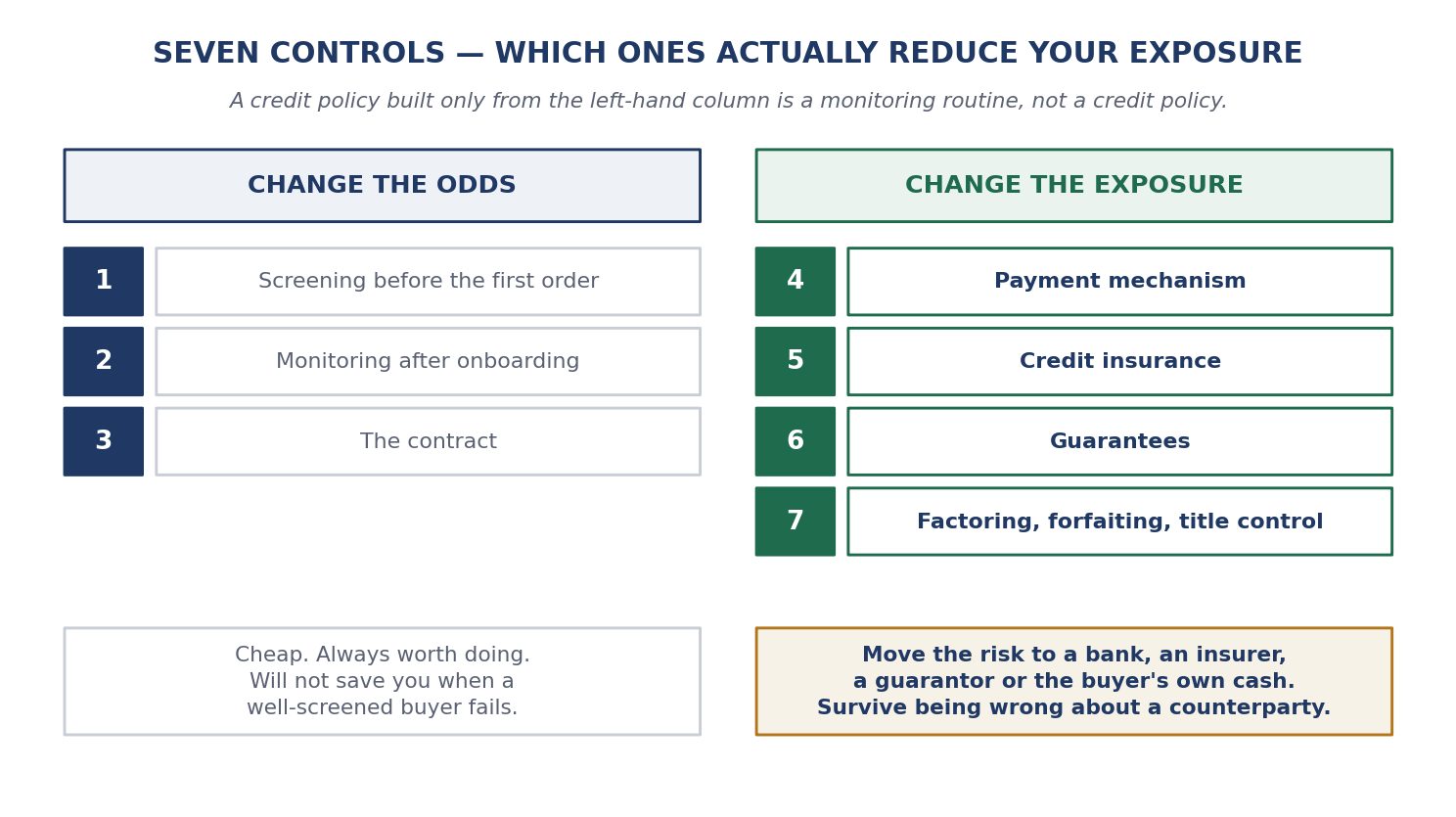
Most advice on protecting export sales presents a list of good practices with no ranking, which leaves the reader to assume they are broadly equivalent. They are not, and the difference is the most useful thing in this guide.
Three of the seven controls change the probability of a loss. They make it less likely a given buyer defaults, or more likely you find out early. They are cheap, they are always worth doing, and they will not save you when a well-screened buyer fails.
Four of them change the exposure itself. They move the risk to a bank, an insurer, a guarantor or the buyer's own cash — so that a default costs you materially less regardless of why it happened. These are the only controls that survive being wrong about a counterparty.
A credit policy built entirely from the first group is not a credit policy. It is a monitoring routine.
The controls that change the odds
Control 1 · Screening before the first order
What it costs: a few hours of analyst time and, in most jurisdictions, under US$200 in registry and bureau fees.
What it does: removes the counterparties that were never going to pay — the entity that does not exist, the near-name group company with no assets, the recently incorporated buyer placing an unusually large first order, the directors with a trail of dissolved companies, the business whose statutory accounts stopped being filed two years ago.
The full protocol — nine layers, the country-by-country registry table, the fifteen red-flag patterns and a weighted scoring model — is in What to Look For in a Counterparty Before Doing Cross-Border Sales. The single highest-value element is the cheapest: verify the registration number the buyer gives you, on the register of the buyer's own country, before you quote.
What it does not do: protect you against a currency shock, a regulatory ban, a customs reclassification, the loss of the buyer's own largest customer, or invoice fraud. A clean screen is not security.
Control 2 · Monitoring after onboarding
Screening once and never again is how good accounts become bad debts. Exposure grows, management changes, and the balance sheet you assessed is eighteen months old by the time you need it.
| Trigger | Action |
|---|---|
| Monthly | Automated register watch — status change, new charge, director change, insolvency filing |
| Quarterly | Filing-compliance check. In India, GST return-filing status; elsewhere, statutory accounts |
| On each new accounts filing | Re-read the audit report; recompute days payable outstanding |
| On any order materially above the established pattern | Full re-screen. Treat it as a new counterparty. This is the bust-out pattern: small orders paid perfectly to build a credit file, then one large one. |
| On the first missed payment | Refresh encumbrance, litigation and trade-activity checks |
| On any request to change bank details | Voice verification on a number you already held. No exceptions, ever. |
That last line is not a credit control. It is a fraud control, and it protects against a loss that hits companies with perfect credit files — payment-diversion fraud, where a compromised or spoofed email redirects payment. It belongs in this list because it is the single cheapest control on it and because no amount of counterparty quality substitutes for it.
Control 3 · The contract
Terms cost nothing at signature and decide the outcome three years later. Six that matter in every market:
- An arbitration clause, with the seat, the governing law of the contract and the governing law of the arbitration agreement stated as three separate things. Most trading nations are New York Convention states, so an award travels where a judgment does not. This is the highest-value single line in a cross-border contract.
- Entity identification — the buyer's registration number, tax number and registered legal name on the face of the contract, with a statement that orders placed by or deliveries made to an affiliate do not vary the buyer's identity.
- An acknowledgement covenant — a written confirmation of the balance within fifteen days of request. Limitation periods differ by country and a written acknowledgement restarts the clock in most of them.
- Interest stated in figures, in the body of the contract, plus recovery of collection and legal costs. An interest rate printed only on the invoice footer is frequently not part of the bargain.
- Express exclusion of unilateral set-off, with the categories named.
- Regulatory allocation — who bears certification, classification and licensing in the destination market, and what happens to payment if goods are detained for a reason within the buyer's control.
But note what a contract is. It gives you a better claim. It does not give you money, and it does not reduce your exposure by a rupee. It belongs in this group, not the next one.
The controls that change the exposure
Control 4 · The payment mechanism
The most powerful control available, and the one most often relaxed to win an order.
| Mechanism | Exposure retained |
|---|---|
| Advance payment | None |
| Irrevocable letter of credit, confirmed by a bank in your own or a strong jurisdiction | Bank risk only. Confirmation is the point — an unconfirmed credit leaves you with the issuing bank's and its country's risk. |
| Standby LC or bank guarantee alongside open account | Bank risk |
| Documents against payment | Goods risk if documents are refused — you still own goods in a foreign port |
| Documents against acceptance | Full credit risk from acceptance onward |
| Open account | Full credit risk |
The discipline that makes an LC work is documentary. Presentations are examined under UCP 600, discrepancies are the norm rather than the exception, and a refused presentation with an unanswered discrepancy notice is a materially different position from an unpaid open account. Collections run under URC 522 and demand guarantees under URDG 758. Treat document preparation as a credit control function, not a shipping clerk's task — a discrepant presentation converts your bank risk back into buyer risk in a single afternoon.
Control 5 · Credit insurance
Cover for buyer default, insolvency and political risk, from an export credit agency or a private insurer.
It genuinely transfers exposure. And in practice it is lost more often through administration than through anything the debtor does. The three rules:
- Notify an overdue within the policy's stated window. Notification is not a claim. Late notification is the single most common reason cover fails.
- Never grant an extension of time, agree a settlement, or accept a reduced sum without the insurer's prior consent. Almost every policy prohibits it.
- Keep declarations and premium current. An undeclared shipment is an uncovered shipment.
Read your own policy schedule. Do not work from a summary, and do not assume two policies from the same insurer carry the same windows.
Control 6 · Guarantees
Bank guarantees and standby letters of credit transfer the risk to a bank. Straightforward, and the buyer pays for them out of its own facility, which is why buyers resist.
Personal and parent guarantees are the underused ones.
- A promoter's personal guarantee, in a promoter-led market, reaches the individual who actually decides payment, and survives the company's failure. In India it also brings the personal-guarantor provisions of the insolvency framework into play.
- A parent company guarantee is worth having. A comfort letter is not a guarantee and is frequently worth nothing when tested. If the group's support is real, ask for the guarantee. If the group will not give one, you have learned something important about the credit.
Control 7 · Factoring, forfaiting and title control
Export factoring and forfaiting convert a receivable into cash. The distinction that matters is with recourse or without — only non-recourse arrangements actually transfer the credit risk; with-recourse factoring is financing, not protection, and many users do not know which they hold.
Title and document control is the weakest instrument in this section, but it is not nothing.
- Retention of title is recognised in most jurisdictions, but it protects only unsold, identifiable, unaltered goods still in the buyer's possession, it is usually defeated against a bona fide sub-purchaser, and insolvency regimes commonly block repossession once a process begins. In India, it arises under Section 25(1) of the Sale of Goods Act, 1930, is defeated on resale under Section 30(2), and is blocked by Section 14(1)(d) of the Insolvency and Bankruptcy Code once a resolution process starts.
- Control of the transport documents matters more than the clause. Where the buyer nominates the forwarder and controls the bill of lading, cargo can be released without presentation of the original — and you have lost control of the goods before you are paid. Nominate your own forwarder, or do not ship on a "to order" basis without securing the documents.
- In the United States specifically, a purchase money security interest perfected by a UCC-1 filing converts a supplier from unsecured to secured in the goods supplied. It is cheap, administrative, and almost never used by non-US sellers.
Building the portfolio
The controls are not applied uniformly. They are applied against the score.
| Screening band | Payment mechanism | Additional controls |
|---|---|---|
| Strong | Open account at requested terms | Monitoring; contract terms; annual review |
| Good | Open account with a reduced limit, or standby LC above a threshold | Monitoring; insurance on the portfolio; half-yearly review |
| Adequate | Confirmed LC, or documents against payment | Guarantee sought; insurance; quarterly review |
| Weak | Prepayment or confirmed LC only | No open account at any limit |
| Any single fatal finding | Cash in advance, or decline | — |
Two rules that stop this becoming theatre:
Concentration is a risk in its own right. A portfolio of well-screened buyers in one country, one sector or one cluster is a single risk wearing twenty names. Cap exposure by market and by sector as well as by counterparty.
No single function should be able to change the payment mechanism alone. Every material loss in cross-border trade has, somewhere in its history, a moment where a payment term was relaxed to win an order without a credit decision.
Questions exporters ask
We screen carefully. Isn't that enough?
No. Screening changes the probability of loss. It does not change the exposure. A well-screened buyer that loses its own largest customer will still fail, and you will still be unsecured. Screening belongs with monitoring and contract terms in the first group; you need at least one control from the second.
Is credit insurance worth it?
It is the most efficient exposure transfer available for an open-account book — provided you administer it. Cover is lost far more often through late notification or an unconsented settlement than through a disputed claim.
Our buyer refuses a letter of credit and says everyone else gives them open account.
Then price the credit accordingly, take a guarantee, insure the exposure, or reduce the limit. All four are available. Matching a competitor's terms without matching their loss appetite is not a decision, it is a drift.
Is retention of title worth including?
Include it — it costs nothing and it is a negotiating asset. Do not price it as security. It protects unsold, identifiable goods in the buyer's possession and very little else.
What is the single highest-return change most exporters could make?
Two, jointly: put an arbitration clause in every cross-border contract, and verify bank-detail changes by voice on a previously held number. The first decides whether your claim is worth anything; the second prevents a loss that has nothing to do with the buyer's credit at all.
How often should we re-screen?
Monthly automated register watch, quarterly filing check, full re-screen on any order materially above the established pattern, and an immediate refresh on the first missed payment.
What this guide cannot tell you
This guide ranks seven controls. It cannot tell you which ones your business is actually running, or where the gap is.
- Which controls are you genuinely operating? Most exporters run three of the seven and believe they run five. The gap is usually in the four that change exposure rather than odds.
- Is your credit policy being overridden? Almost every material loss has a moment where a payment term was relaxed to win an order without a credit decision. That is visible in the data.
- Where is your concentration? A portfolio of well-screened buyers in one market or one cluster is a single risk wearing twenty names.
- Is your insurance administratively sound? Notification windows, consent requirements and declaration currency, checked against your actual policy schedule rather than a summary.
- Do your contracts carry the six terms? Arbitration clause, entity identification, acknowledgement covenant, interest in figures, set-off exclusion, regulatory allocation. Assessed against your actual standard terms.
- What would a default cost you today? Exposure by counterparty, by market and by mechanism, against what is actually secured.
The Foreign Debtor Recovery Position Report
Those questions have answers. They are specific to your debtor, your documents and your dates, and none of them can be found in a guide.
The Foreign Debtor Recovery Position Report is a fixed-fee written assessment of your particular debtor and the routes actually open to you.
| What it contains | The verified legal identity and current standing of the debtor · its financial position, registered charges, litigation history and compliance filings · why the money is stuck — the status of the underlying project or contract, whether the debtor is itself waiting on a government department or a main contractor, the effect of any change of administration or management, and our assessment of whether this is an inability to pay or an unwillingness to pay · whether a pre-existing dispute exists in your own file and what it closes off · the limitation position on your facts and dates · the routes open to you, ranked, with indicative cost, timeline and realistic recovery for each · what we would do first |
| What we need from you | The contract or purchase order, the invoices in dispute, a full statement of account, transport and delivery documents, all correspondence including every complaint and debit note, any acknowledgement or part payment, and your insurance position |
| Coverage | Depth varies by the debtor's jurisdiction and legal form. Incorporated entities are documented in most markets; sole traders and partnerships far less so — we will still make the enquiry, and we will tell you plainly what could and could not be established. |
| Turnaround | 7 to 10 working days from receipt of a complete file |
| Fee | Fixed, and quoted before we begin. The report is chargeable in every case. Where you go on to instruct us and we recover, the fee is credited against the success fee actually earned. |
| Additional work | Anything beyond the scope of the report — further enquiry, additional debtors, field verification — is quoted separately before it is done. |
| If you instruct us to recover | We work on a success fee. The debtor pays you directly — client money never enters our account. |
GGA India Private Limited · Corporate Office — 294, Phase 4, Gurugram, Haryana – 122016 · gg@ggaindia.co.in · ggaindia.com
Verification log
| Item | Where to re-verify |
|---|---|
| UCP 600, URC 522 and URDG 758 as currently in force | International Chamber of Commerce |
| Incoterms edition in use and its rules on risk transfer and document control | International Chamber of Commerce |
| Export credit agency and private insurer notification, consent and claim requirements | Read your own policy schedule |
| Recourse status and terms of any factoring or forfaiting facility | Your facility agreement |
| Retention of title enforceability in the destination market | Counsel in that market |
| UCC-1 filing and perfection requirements for a purchase money security interest in the United States | US counsel |
| Notified New York Convention territories for the seat you choose | The relevant national gazette |
Companion guides: the screening protocol is in "What to Look For in a Counterparty Before Doing Cross-Border Sales"; the regulatory lifecycle for Indian exporters is in "Indian Exporters Selling to Overseas Buyers"; market-specific recovery is in the corridor guides.
This guide is a commercial reference for exporters, credit and risk professionals. It is not legal, insurance or financial advice.
Have a live cross-border receivable?
Share the creditor and debtor countries, unpaid value, ageing and available evidence so GGA can review the scope and next step. GGA takes cross-border cases from USD 20,000. Fees are agreed before recovery begins; a Recovery Position Report is optional and is not required to place a claim.