India–Singapore Receivables
General information, not legal or financial advice. Terms of Use.
On this page
- Layer 1 · Who did you actually contract with?
- Layer 2 · Where is the operating business?
- Layer 3 · What reaches the operating business?
- Layer 4 · The clauses that make the trace work
- Layer 5 · If it goes to the Indian side
- Questions creditors ask in this corridor
- What this guide cannot tell you
- Verification log
Follow the entity. In this corridor, the company you are contracting with is very often not where the money is.
Singapore is a notified reciprocating territory under Section 44A of the Indian Code of Civil Procedure — a money decree of the Supreme Court of Singapore is executed in an Indian District Court as though passed there. India and Singapore trade under the Comprehensive Economic Cooperation Agreement, in force since 2005. And Singapore is the most-used arbitral seat for India-facing contracts anywhere in the world.
On paper, then, this is the easiest corridor in the series. In practice it is the one where creditors most often discover, at month nine, that they have a perfectly enforceable claim against a company holding nothing.
That is because Singapore is not only a trading partner of India. It is India's principal holding and treasury jurisdiction. A very large number of "Singapore" counterparties in this corridor are trading, holding or procurement arms of Indian groups, of Chinese groups selling into India, or of multinationals structuring their Asian flows. The paid-up capital may be nominal, the staff may number three, and the substance may sit entirely in Mumbai or Shenzhen.
So this guide is organised as a trace. We follow the claim through the entity structure, and at each layer ask the same question: is this where the money is, and if not, what reaches it?
Layer 1 · Who did you actually contract with?
Start at ACRA BizFile, Singapore's company register. It is fast, cheap and gives you the answer.
| What to pull | What it tells you |
|---|---|
| UEN and entity type | Private limited, branch of a foreign company, or LLP. A branch has no separate legal personality — you are contracting with the foreign head office, which changes everything. |
| Incorporation date and status | Live, struck off, in liquidation, in judicial management |
| Paid-up capital | The single most revealing figure. A S$1,000 or S$10,000 capital against a S$2 million order is the whole story. |
| Shareholders | Where the corporate shareholder is Indian, Chinese, or Mauritian, you have found the layer above |
| Directors | And in particular whether any director is resident in Singapore or whether the board is entirely offshore |
| Filed financial statements | Small exempt private companies may not file accounts — absence is itself information |
| Registered address | A corporate services provider's address for hundreds of companies is not an operating business |
The decision this drives. If the Singapore entity has substance — staff, premises, assets, filed accounts showing a real balance sheet — treat it as your counterparty and proceed normally. If it does not, the credit you are actually taking is Indian, or Chinese, and it should be priced and secured as such. That means a parent guarantee, a letter of credit, or a personal guarantee from the principal — not a contract with the Singapore entity on open account.
Layer 2 · Where is the operating business?
Trace upward and outward:
- The corporate shareholder named in ACRA. If Indian, verify it on the Ministry of Corporate Affairs portal — CIN, status, Index of Charges, directors, and whether accounts are filed on time.
- Common directors. An Indian director's DIN on the MCA portal reveals every other company they run. This is the fastest route to where the operating business, and later the money, actually sits.
- The shipment flow. Did goods ever move through Singapore, or did they ship from India or China direct to the buyer while the invoice went through Singapore? A pure invoicing conduit that never touched the goods is a very different counterparty from a trading house that took title and risk.
- The bank. A payment instruction to an account in a third jurisdiction, for a Singapore-contracted entity, needs an explanation before you accept it, not after.
Layer 3 · What reaches the operating business?
This is where the corridor's advantages become usable.
If the operating business is Indian, you have the full Indian toolkit set out in the pillar reference, and the corridor gives you two additional advantages:
- A Singapore judgment is executable in India under Section 44A CPC, without re-litigating the merits — subject to the Section 13 exceptions being raised in execution. Very few creditor countries have this.
- A SIAC award is enforced in India under Sections 47 to 49 of the Arbitration and Conciliation Act, 1996 as a deemed decree, on the narrow Section 48 grounds only. Singapore is the seat Indian counterparties accept fastest, Indian counsel know it thoroughly, and the enforcement path is well-trodden.
If the Singapore entity itself is the target, Singapore's own process is quick and creditor-friendly. A statutory demand followed by a winding-up application under the Insolvency, Restructuring and Dissolution Act 2018 is a serious instrument against a company that needs its Singapore standing — and many conduit entities need theirs badly, because it is what makes the structure work. That leverage is often out of proportion to the assets actually held.
Layer 4 · The clauses that make the trace work
Everything above is easier if the contract was drafted for it. Six terms, none of which costs anything at signature.
- Name the contracting entity precisely, with its UEN, and — where the counterparty is Indian-owned — require the CIN, PAN and GSTIN of the Indian affiliate as well. State that orders placed by, or deliveries made to, an affiliate do not vary the identity of the buyer.
- A parent guarantee wherever the Singapore entity's paid-up capital is materially below your credit line. This is the single most effective term in the corridor and it is asked for far too rarely, because the Singapore address makes the counterparty feel safer than it is.
- Arbitration, SIAC, seated Singapore. Expedited procedure for lower-value claims. State the seat, the governing law of the contract, and the governing law of the arbitration agreement separately — in Disortho S.A.S. v. Meril Life Sciences Pvt Ltd (2025 INSC 352) the Indian Supreme Court confirmed the arbitration agreement's law is otherwise presumed to follow the main contract's.
- Preserve Section 9 of the Indian Arbitration Act expressly, so you can attach Indian assets while the arbitration runs. The Bombay High Court held in Osterreichischer Lloyd Seereederei (Cyprus) Ltd v. Victore Ships Pvt Ltd (10 March 2026) that this access survives even after the enforcement petition is filed, until the award becomes a deemed decree under Section 49.
- An acknowledgement covenant — a written balance confirmation within fifteen days of request. For Indian claims, check the applicable period and dates; a fresh period under Section 18 requires a qualifying acknowledgement of liability in writing, signed before expiry by the liable party or its duly authorised agent. Singapore's general limitation period for contract claims is six years.
- A Bill of Entry covenant where goods enter India — the buyer's own sworn customs declaration, and the strongest single document against an Indian debtor.
Layer 5 · If it goes to the Indian side
The general machinery is in the pillar reference. Two current points:
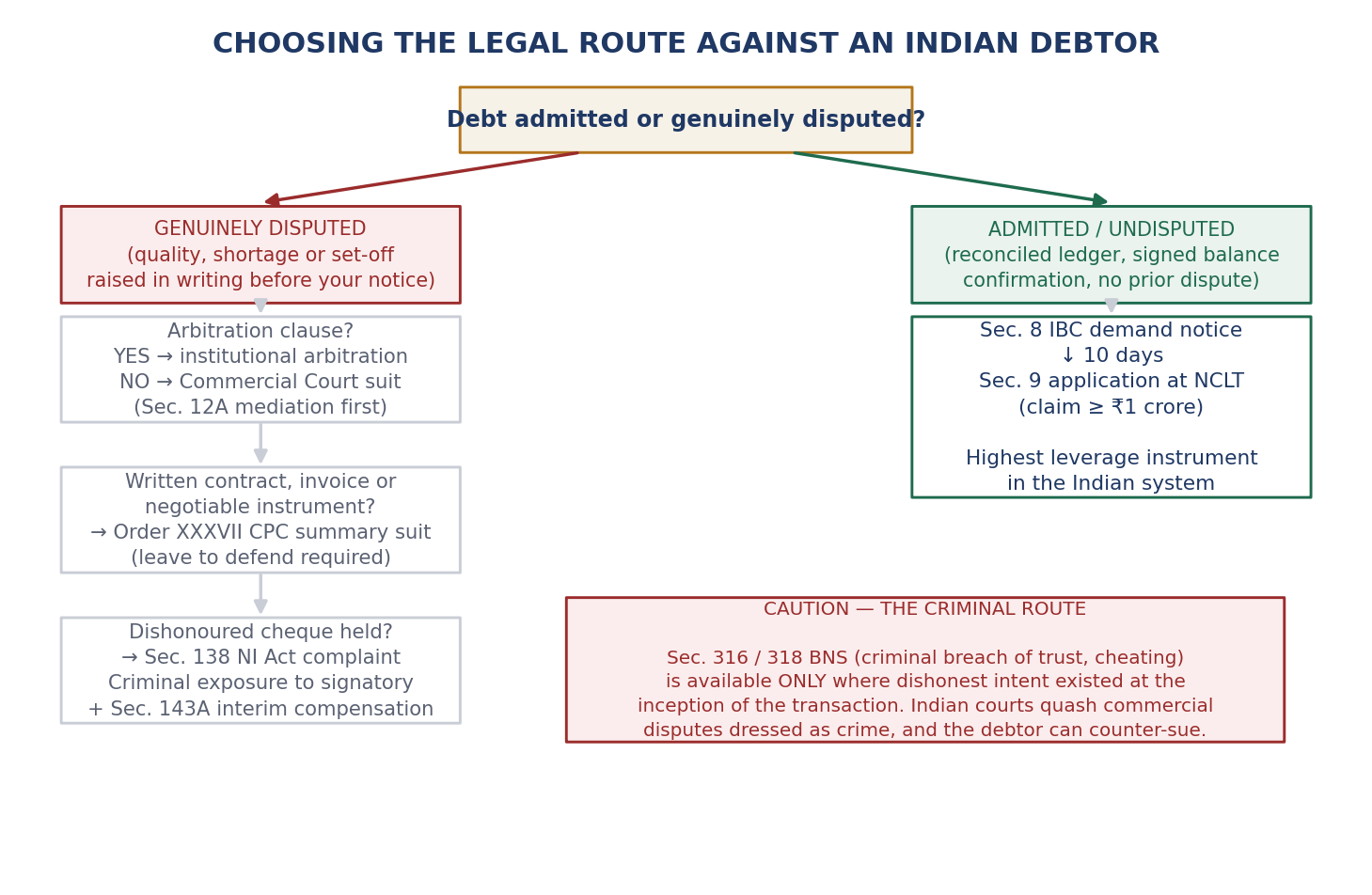
The IBC route changed in April 2026. The Insolvency and Bankruptcy Code (Amendment) Act, 2026 replaced "may" with "shall" in Sections 7, 9 and 10, so admission is close to mechanical once default is shown. But the amended Section 215 now requires an operational creditor to file the financial information with an Information Utility before making a Section 9 application, with the debtor's silence treated as deemed authentication. Threshold ₹1 crore per creditor. New Section 64A penalises frivolous applications.
The Mobilox defence survives the amendments and is now essentially the only obstacle left. Check your own inbox for the buyer's complaints before you serve anything: a plausible dispute raised before your demand notice defeats the application without the tribunal trying its merits.
Questions creditors ask in this corridor
Our customer is a Singapore Pte Ltd. Isn't that lower risk than contracting with an Indian company?
Not automatically, and often the reverse. Singapore's regulatory quality is high, but a Singapore incorporation tells you nothing about capital, substance or assets. Check the paid-up capital and the shareholder against ACRA before you price the risk. A well-run Indian manufacturer with a plant is a better credit than a S$1,000 conduit.
Is a Singapore judgment enforceable in India?
Yes — Singapore is a notified reciprocating territory under Section 44A CPC, and a decree of the Supreme Court of Singapore is executed as if passed by the Indian District Court. The Section 13 exceptions remain available in execution, so a reasoned judgment after proper service is worth far more than a default one.
Why is SIAC used so heavily for India contracts?
Neutrality, English-language common-law procedure, speed, and an enforcement path into India that has been walked many times. Indian counsel and Indian counterparties are entirely familiar with it, which means the clause survives negotiation — which is the test most arbitration clauses fail.
Should we use SIAC or an Indian institution?
SIAC where the amount justifies it and neutrality matters. An Indian seat — MCIA in Mumbai, or DIAC or IIAC in Delhi — is materially cheaper and removes the enforcement conversion step entirely, since a domestic award enforces under Part I of the Arbitration Act. For claims below roughly US$500,000 the cost difference is worth taking seriously.
Can we wind up the Singapore entity to get paid?
A statutory demand and winding-up application under the Insolvency, Restructuring and Dissolution Act 2018 is available, and the process carries weight disproportionate to the entity's assets, because the group usually needs its Singapore standing. Take Singapore advice on the current threshold and procedure, and do not issue a statutory demand where the debt is genuinely disputed.
How do we know whether the Singapore entity has substance?
Paid-up capital, filed accounts, whether any director is Singapore-resident, whether the registered address is a corporate services provider serving hundreds of companies, and whether the goods ever physically moved through Singapore. Four of those are free from ACRA.
What this guide cannot tell you
This guide teaches you to trace the entity. It cannot run the trace on your counterparty, or tell you which end of the chain is worth pursuing.
- Is the Singapore entity an operating business or a conduit? Paid-up capital, filed accounts, resident directors and whether the goods ever moved through Singapore. The answer changes who you should be pursuing.
- Who is the parent, and what is it worth? If the credit you took is really Indian or Chinese, it needs to be assessed as such — filings, charges, litigation and payment behaviour.
- Is a statutory demand available and appropriate? It carries leverage far beyond the conduit's assets, but it must not be used where the debt is genuinely disputed.
- Where do you sue, and where do you enforce? Singapore judgment, SIAC award or Indian proceedings — the right answer depends on where the reachable assets actually are.
- Is the limitation position the same in both jurisdictions? Six years in Singapore, three in India, and different triggers. Which governs your claim is a question about your contract.
- Has anything in your own correspondence closed off a route? The pre-existing dispute problem applies here as everywhere, and it is decided on your documents.
The Indian Debtor Recovery Position Report
Those questions have answers. They are specific to your debtor, your documents and your dates, and none of them can be found in a guide.
The Indian Debtor Recovery Position Report is a fixed-fee written assessment of your particular debtor and the routes actually open to you.
| What it contains | The verified legal identity and current standing of the debtor · its financial position, registered charges, litigation history and compliance filings · why the money is stuck — the status of the underlying project or contract, whether the debtor is itself waiting on a government department or a main contractor, the effect of any change of administration or management, and our assessment of whether this is an inability to pay or an unwillingness to pay · whether a pre-existing dispute exists in your own file and what it closes off · the limitation position on your facts and dates · the routes open to you, ranked, with indicative cost, timeline and realistic recovery for each · what we would do first |
| What we need from you | The contract or purchase order, the invoices in dispute, a full statement of account, transport and delivery documents, all correspondence including every complaint and debit note, any acknowledgement or part payment, and your insurance position |
| Coverage | Detailed reporting is available for companies and LLPs, which file publicly in India. For proprietorships and partnership firms the public and government record is thin — we will still make the enquiry, and we will tell you plainly what could and could not be established. |
| Turnaround | 7 to 10 working days from receipt of a complete file |
| Fee | Fixed, and quoted before we begin. The report is chargeable in every case. Where you go on to instruct us and we recover, the fee is credited against the success fee actually earned. |
| Additional work | Anything beyond the scope of the report — further enquiry, additional debtors, field verification — is quoted separately before it is done. |
| If you instruct us to recover | We work on a success fee. The debtor pays you directly — client money never enters our account. |
GGA India Private Limited · Corporate Office — 294, Phase 4, Gurugram, Haryana – 122016 · gg@ggaindia.co.in · ggaindia.com
Verification log
| Item | Where to re-verify |
|---|---|
| Section 44A notification covering Singapore and the specified superior court | Gazette notifications under Section 44A CPC |
| The reverse position — recognition of Indian judgments in Singapore under Singapore's reciprocal enforcement legislation, which has been amended in recent years | Singapore Statutes Online; Singapore counsel |
| Singapore's ratification status under the Singapore Convention on Mediation, and India's | UNCITRAL; Ministry of Law, Singapore; Ministry of Law and Justice, India |
| Statutory demand threshold and winding-up procedure under the IRDA 2018 | Singapore Statutes Online |
| SIAC Rules currently in force, and the expedited procedure threshold | SIAC |
| IBC (Amendment) Act, 2026 subordinate legislation, in particular Section 215 compliance for a foreign creditor | IBBI; Ministry of Corporate Affairs |
| India–Singapore CECA tariff schedules and rules of origin | Department of Commerce, Government of India; Enterprise Singapore |
Companion guide: the entity-substance problem in this guide recurs in "China–India B2B Receivables", where Hong Kong and Singapore intermediaries play the same role. Full statutory mechanics for the Indian side are in the pillar reference.
This guide is a commercial and procedural reference for credit, collections and risk professionals. It is not legal advice, and Singapore law positions should be confirmed with Singapore counsel.
Have a live cross-border receivable?
Share the creditor and debtor countries, unpaid value, ageing and available evidence so GGA can review the scope and next step. GGA takes cross-border cases from USD 20,000. Fees are agreed before recovery begins; a Recovery Position Report is optional and is not required to place a claim.