China–India B2B Receivables
General information, not legal or financial advice. Terms of Use.
On this page
- Failure Mode 1 · The chop
- Failure Mode 2 · The entity that never existed
- Failure Mode 3 · The intermediary
- Failure Mode 4 · The goods that never cleared
- Failure Mode 5 · The money that cannot move
- Failure Mode 6 · The security that was never…
- If it has already gone wrong
- Questions creditors ask in this corridor
- What this guide cannot tell you
- Verification log
A catalogue of failure modes. In this corridor, losses do not come from bad luck — they come from six recognisable mechanical faults, and each has a fix.
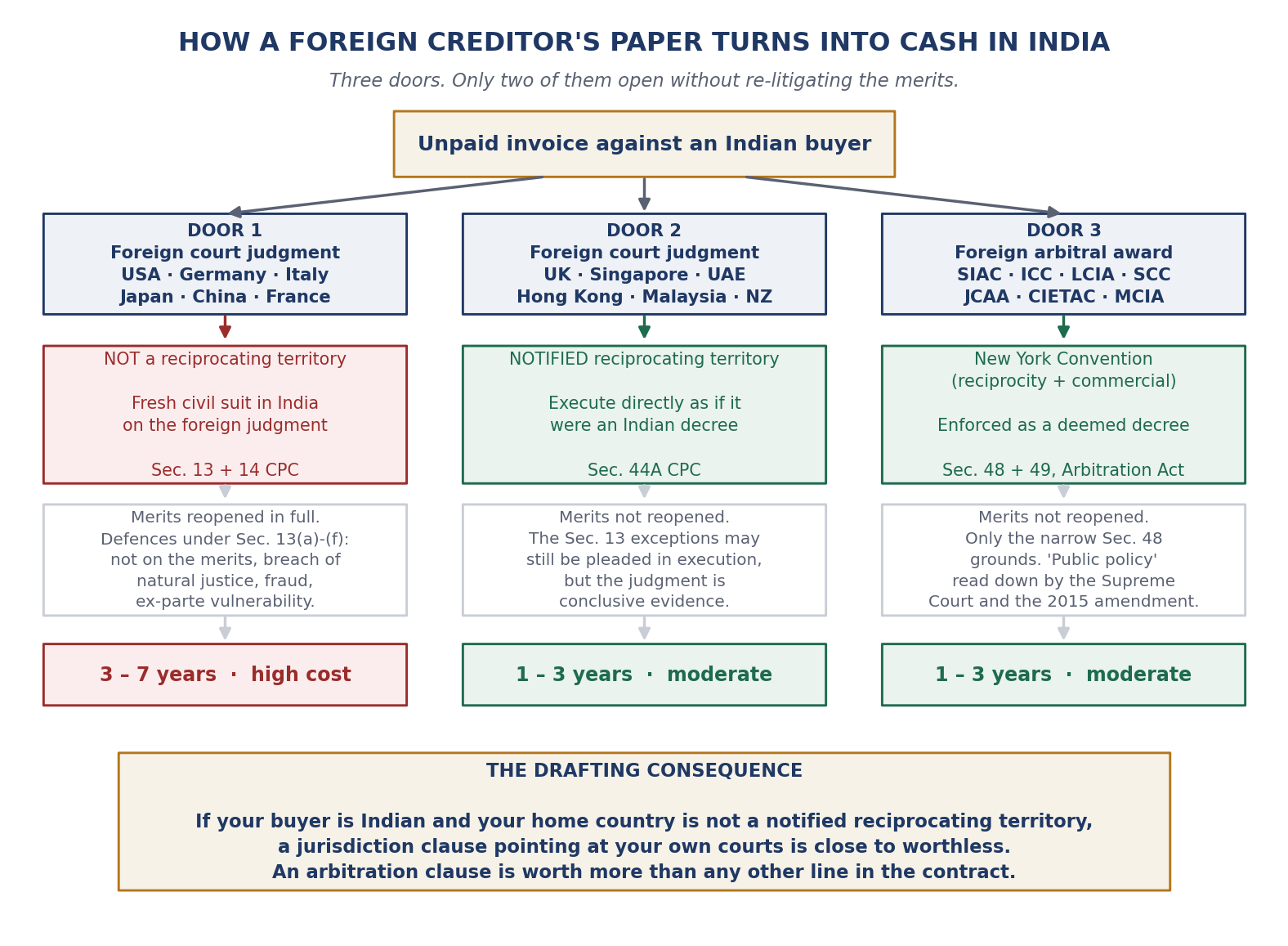
Neither country enforces the other's court judgments. There is no reciprocity notification in either direction, so a judgment obtained in Shanghai has to be sued upon afresh in India under Section 13 of the Indian Code of Civil Procedure, and an Indian judgment faces its own obstacles in the People's Republic. What both countries are is New York Convention states, and both are notified for the purposes of each other's reservations.
So the enforcement answer in this corridor is short: arbitrate, or contract through Hong Kong. The rest of this guide is about the things that go wrong before enforcement is ever reached — because in the China–India corridor, most losses are not enforcement failures. They are documentation, entity and regulatory failures that were fixable at the outset and became unfixable by the time anyone looked.
Six failure modes. Each with the signature, the mechanism, and the fix.
Failure Mode 1 · The chop
Signature. A signed contract, a clear breach, and a counterparty that calmly denies the contract binds it.
The mechanism. In the People's Republic, a company is bound by its company chop (公章) — the official seal — not primarily by a signature. A contract bearing the chop binds the company even where the signatory lacked authority. A contract bearing only a signature, from someone without demonstrable authority, may not bind it at all. Foreign parties, trained on signature blocks, routinely accept the wrong one.
Alongside the chop sits the legal representative (法定代表人) — a single named individual registered with the authorities who has statutory power to bind the company. That name is on the public register.
The fix. Take the chop, in red ink, over the signature page and across page joins. Verify the chop against the one on the counterparty's business licence. Identify the legal representative from the register and have them sign as well. Where you are the Indian party, apply the same discipline in reverse: an Indian company's common seal is no longer generally required, so your Chinese counterparty will want a board resolution instead — give them one, and take theirs.
Failure Mode 2 · The entity that never existed
Signature. Payment stops, communication stops, and the company on the invoice cannot be found.
The mechanism. The trading name on the pro forma invoice is an English marketing name that corresponds to no registered entity. Or it corresponds to a Hong Kong company with no assets, while the factory is a separate mainland entity that was never a party to anything.
The fix — free, and it takes twenty minutes.
| Check | Source |
|---|---|
| Unified Social Credit Code — the 18-digit identifier. Verify the exact registered Chinese name, registered capital, status, scope of business and legal representative | National Enterprise Credit Information Publicity System (GSXT) |
| Litigation history and judgments against the entity | China Judgments Online |
| Whether the entity or its legal representative appears on the Supreme People's Court list of dishonest judgment debtors — a public enforcement blacklist | Supreme People's Court enforcement information system |
| Hong Kong intermediaries | Hong Kong Companies Registry (ICRIS) |
| Indian counterparties | MCA portal — CIN, status, Index of Charges, directors; GST filing status; EPFO |
The dishonest-debtor blacklist deserves particular attention. It is free, public, and it lists parties who have failed to satisfy enforceable judgments — with real consequences for them, including restrictions on air and high-speed rail travel. A counterparty on that list is telling you something no credit report will.
Insist that the registered Chinese name and the Unified Social Credit Code appear on the contract, alongside the English trading name. Where the counterparty resists, that is the answer.
Failure Mode 3 · The intermediary
Signature. Goods came from a mainland factory. The invoice came from a Hong Kong or Singapore company. Payment was requested to a third account. Now nobody is responsible.
The mechanism. A great deal of China–India trade is routed through intermediaries in Hong Kong or Singapore for reasons that are entirely legitimate — foreign exchange administration on the mainland side, banking convenience, and group treasury structures. The effect on a creditor is that the entity with the assets, the entity with the contract and the entity that received the money are three different companies in three jurisdictions.
The fix, and the opportunity.
Whichever entity you contract with, require that the contracting party, the invoicing party and the payee are the same legal person, and refuse third-party payment instructions without a written explanation you have verified independently.
Failure Mode 4 · The goods that never cleared
Signature. The buyer is apologetic rather than argumentative. The goods are at an Indian port. Demurrage is running. Nobody is paying anybody.
The mechanism. This is the dominant cause of genuine dispute in the corridor, and it falls hardest on Chinese exporters to India. India applies Quality Control Orders and BIS certification requirements to a widening list of products, alongside anti-dumping and countervailing duties on specific tariff lines, many of them aimed at Chinese-origin goods. A consignment arriving without the required certification, or reclassified into a line carrying an anti-dumping duty the buyer did not price for, cannot be cleared and cannot be sold.
The Indian buyer is not refusing to pay out of bad faith. It is holding goods it cannot use and paying storage on them.
Why this matters beyond the consignment. A regulatory hold is a genuine dispute. Under Mobilox Innovations v. Kirusa Software, a plausible contention of a dispute pre-dating your demand notice defeats an application under Section 9 of the Insolvency and Bankruptcy Code, and the tribunal will not try its merits. One stranded container can close off the strongest instrument in the Indian system for the whole account.
The fix. Check the BIS certification and QCO position for the product line before shipment, verify the HS classification and any anti-dumping exposure, and put responsibility for certification, classification and licensing in the contract in terms — with an express statement of what happens to the payment obligation if goods are detained for a reason within the buyer's control. Where the goods are stranded, treat it as a joint problem to solve rather than a debt to demand: the fastest route to payment is usually clearance.
Failure Mode 5 · The money that cannot move
Signature. Both sides agree the debt. Neither side can complete the payment.
The mechanism. Two separate exchange-control regimes, each capable of stopping a legitimate remittance:
- On the Indian side, import payments run through an authorised dealer bank under the Reserve Bank of India's framework, and evidence of import is monitored through the Import Data Processing and Monitoring System (IDPMS). If the Bill of Entry has not been uploaded, or its value does not reconcile to the invoice value, the bank will not release the remittance. Outstanding IDPMS entries against earlier consignments constrain the buyer's ability to remit at all.
- On the Chinese side, foreign exchange administration requirements govern outward and inward flows and can delay receipts.
The fix. Ask the direct question, in writing: "Which bank is processing this remittance and what document is it waiting for?" It is answered more often than foreign creditors expect, and the fix is frequently a corrected commercial invoice or a signed amendment reconciling invoice value to Bill of Entry value. A demand letter solves none of this, and burns a relationship that is about to become productive again.
Failure Mode 6 · The security that was never available
Signature. The claim is good, the award is obtained, and there is nothing to enforce against.
The mechanism. Creditors in this corridor plan enforcement after default rather than before contract. By then the options have closed. And in the India-facing direction there is a specific constraint: India applies investment-screening rules to entities from countries sharing a land border with India, which affects any attempt by a Chinese party to take equity or certain asset security over an Indian counterparty. Assuming a security structure will be available and discovering later that it requires approval is a recurring and expensive error.
The fix — decide the enforcement architecture at contract stage.
| Instrument | Verdict in this corridor |
|---|---|
| Irrevocable letter of credit, confirmed | The strongest ordinary protection in both directions, and the historic norm in this trade before terms loosened |
| Arbitration clause — CIETAC, SHIAC or BAC seated in the PRC, HKIAC in Hong Kong, or SIAC in Singapore | Essential. Both countries are New York Convention states and awards enforce. SIAC and HKIAC are the usual neutral compromises. |
| Contracting through the Hong Kong entity where one exists | Converts Section 13 into Section 44A for Indian enforcement. See Failure Mode 3. |
| Bank guarantee or standby LC | Good, and obtainable from mid-market buyers wanting longer terms |
| Retention of title | Recognised in India under Section 25(1) of the Sale of Goods Act, 1930 but defeated on resale under Section 30(2) and blocked by Section 14(1)(d) of the IBC once insolvency starts. A negotiating asset, not security. |
| Equity or asset security over an Indian counterparty, taken by a Chinese party | Do not assume it is available. Take Indian advice on the investment-screening position first. |
If it has already gone wrong
The general Indian machinery is in the pillar reference. Three corridor-specific points:
Check your own inbox first. Every quality complaint, short-shipment claim and certification query in your sent items is a potential Mobilox dispute. In this corridor, where regulatory holds are common, that inbox is fuller than in any other.
The IBC route changed in April 2026. The Insolvency and Bankruptcy Code (Amendment) Act, 2026 replaced "may" with "shall" in Sections 7, 9 and 10 — admission is close to mechanical once default is shown. But the amended Section 215 requires an operational creditor to file the debt information with an Information Utility before applying under Section 9, with the debtor's silence treated as deemed authentication. Threshold ₹1 crore per creditor. New Section 64A penalises frivolous applications.
Many Indian trade-debt claims have a three-year period, but the applicable cause of action and dates must be checked. A qualifying acknowledgement must recognise the relevant liability in writing and be signed before the applicable period expires by the liable party or its duly authorised agent. A fresh period under Section 18 runs from signing. For Section 19, payment must be made before expiry by the liable party or its duly authorised agent, with acknowledgement of that payment in the payer’s handwriting or in writing signed by the payer. A fresh period runs from payment. See the statutory conditions in Part 2 of the India recovery guide. Keep the relevant documents and review the dates while the balance remains open.
Questions creditors ask in this corridor
Our contract is signed but has no chop. Is it valid?
Take Chinese advice on the specific facts. A chop is the ordinary and expected way a PRC company binds itself, and its absence is a real vulnerability. For future contracts, take the chop and have the legal representative sign.
Can we enforce a Chinese court judgment in India?
Not directly. China is not a notified reciprocating territory under Section 44A CPC, so you would need a fresh suit in India under Section 13 CPC with the merits reopened. An arbitral award is the answer.
Our counterparty invoices from Hong Kong. Is that a problem?
It is an opportunity, if you make it deliberate. Hong Kong is a notified reciprocating territory for Section 44A execution in India, and the mainland is not — so a Hong Kong-contracted claim gives you a route into Indian assets that a mainland-contracted claim does not.
Our goods are stuck at an Indian port over BIS certification and the buyer has stopped paying.
That is a genuine dispute, not a delinquency, and it will defeat an IBC application. Solve the clearance problem first — it is also the fastest route to payment. Then fix the contract for the next shipment so certification responsibility is allocated in terms.
Which arbitral seat should we choose?
HKIAC or SIAC are the usual neutral compromises and both enforce cleanly in India. CIETAC or SHIAC where your counterparty insists on a PRC seat — still enforceable in India under the New York Convention, but less comfortable for an Indian party in negotiation.
Where do we check a Chinese company for free?
The National Enterprise Credit Information Publicity System for registration, capital and legal representative; China Judgments Online for litigation; and the Supreme People's Court list of dishonest judgment debtors for enforcement failures. All three are public.
What this guide cannot tell you
This guide catalogues six failure modes. It cannot tell you which one you are in — and two of them look identical until somebody checks the register.
- Does your counterparty exist as described? Registered Chinese name, Unified Social Credit Code, capital, status and legal representative — verified, not taken from the pro forma invoice.
- Is your contract binding? Whether the chop was applied, by whom, and whether it matches the business licence, decides whether you have a contract at all.
- Which entity in the chain should you be pursuing? Mainland factory, Hong Kong invoicing company, Singapore intermediary. One of them may give you an enforcement route into India that the others do not.
- Is your counterparty already on an enforcement blacklist? Judgment records and the dishonest-debtor list are public and free. Almost nobody checks them before shipping.
- Is the payment blocked or refused? Goods stranded on certification, an exchange-control hold, or a genuine refusal look the same from a distance and need opposite responses.
- Can you take security at all? Investment-screening rules affect what a Chinese party can take over an Indian counterparty. Assuming a structure is available and finding out later is expensive.
The Indian Debtor Recovery Position Report
Those questions have answers. They are specific to your debtor, your documents and your dates, and none of them can be found in a guide.
The Indian Debtor Recovery Position Report is a fixed-fee written assessment of your particular debtor and the routes actually open to you.
| What it contains | The verified legal identity and current standing of the debtor · its financial position, registered charges, litigation history and compliance filings · why the money is stuck — the status of the underlying project or contract, whether the debtor is itself waiting on a government department or a main contractor, the effect of any change of administration or management, and our assessment of whether this is an inability to pay or an unwillingness to pay · whether a pre-existing dispute exists in your own file and what it closes off · the limitation position on your facts and dates · the routes open to you, ranked, with indicative cost, timeline and realistic recovery for each · what we would do first |
| What we need from you | The contract or purchase order, the invoices in dispute, a full statement of account, transport and delivery documents, all correspondence including every complaint and debit note, any acknowledgement or part payment, and your insurance position |
| Coverage | Detailed reporting is available for companies and LLPs, which file publicly in India. For proprietorships and partnership firms the public and government record is thin — we will still make the enquiry, and we will tell you plainly what could and could not be established. |
| Turnaround | 7 to 10 working days from receipt of a complete file |
| Fee | Fixed, and quoted before we begin. The report is chargeable in every case. Where you go on to instruct us and we recover, the fee is credited against the success fee actually earned. |
| Additional work | Anything beyond the scope of the report — further enquiry, additional debtors, field verification — is quoted separately before it is done. |
| If you instruct us to recover | We work on a success fee. The debtor pays you directly — client money never enters our account. |
GGA India Private Limited · Corporate Office — 294, Phase 4, Gurugram, Haryana – 122016 · gg@ggaindia.co.in · ggaindia.com
Verification log
| Item | Where to re-verify |
|---|---|
| Reciprocating-territory status of Hong Kong under Section 44A CPC | Gazette notifications under Section 44A CPC |
| Product-wise BIS certification and Quality Control Order coverage; anti-dumping and countervailing duties on relevant tariff lines | Bureau of Indian Standards; Directorate General of Trade Remedies |
| India's investment-screening rules for entities from bordering countries, and their reach over security interests | Department for Promotion of Industry and Internal Trade |
| PRC foreign exchange administration requirements on inward and outward remittance | State Administration of Foreign Exchange |
| RBI import remittance and IDPMS requirements | RBI Master Direction on Import of Goods and Services |
| IBC (Amendment) Act, 2026 subordinate legislation, including Section 215 compliance for a foreign creditor | IBBI; Ministry of Corporate Affairs |
| Arbitration rules currently in force at CIETAC, SHIAC, HKIAC and SIAC | The relevant institution |
Companion guide: the intermediary-entity problem here is the same one covered from the other side in "India–Singapore Receivables". Full statutory mechanics for the Indian side are in the pillar reference.
This guide is a commercial and procedural reference for credit, collections and risk professionals. It is not legal advice, and PRC and Hong Kong law positions should be confirmed with local counsel.
Have a live cross-border receivable?
Share the creditor and debtor countries, unpaid value, ageing and available evidence so GGA can review the scope and next step. GGA takes cross-border cases from USD 20,000. Fees are agreed before recovery begins; a Recovery Position Report is optional and is not required to place a claim.