India–UAE Trade and Payment
General information, not legal or financial advice. Terms of Use.
On this page
The only corridor in this series that works cleanly in both directions — and the routing decision that unlocks it
Almost every guide in this series ends at the same place: your judgment will not travel to India, so arbitrate. The UAE corridor is the exception, and it is worth understanding why, because the consequence reaches far beyond UAE companies.
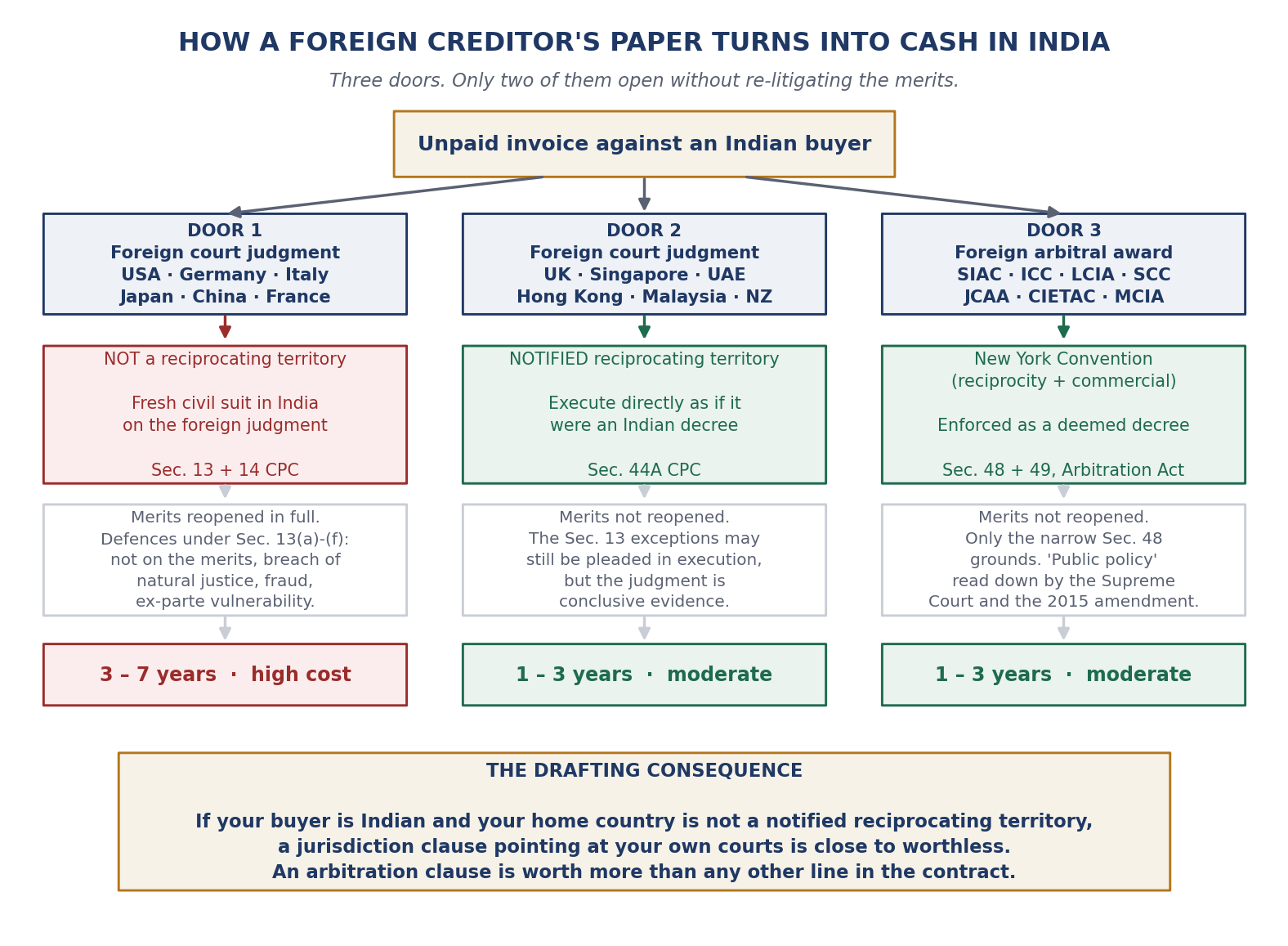
The United Arab Emirates was notified as a reciprocating territory under Section 44A of the Indian Code of Civil Procedure on 17 January 2020, by G.S.R. 38(E), gazetted the following day. A money decree of a notified UAE superior court is executed in an Indian District Court as if an Indian court had passed it. No fresh suit. No reopening of the merits.
The notified superior courts include the Federal Supreme Court, the Federal First Instance and Appeals Courts in Abu Dhabi, Sharjah, Ajman, Umm Al Quwain and Fujairah, the Abu Dhabi Judicial Department, the Dubai Courts, the Ras Al Khaimah Judicial Department, and — the detail that matters most — the ADGM Courts and the DIFC Courts.
And the reverse leg works too. Under the India–UAE Agreement on Juridical and Judicial Cooperation in Civil and Commercial Matters, 1999, ratified by both states, an Indian judgment is enforceable in the UAE through the execution route. This is the only major corridor in the series where paper moves in both directions without re-litigation.
Part One · The routing decision
This guide is built around a single comparison, because for most sellers into India the UAE corridor presents a choice rather than a set of facts. If you are a European, Asian or American group with any UAE presence — a trading arm, a regional office, a free zone entity — you can choose which contract governs your Indian sales.
Route A · Contract from your home entity, home courts
Applies to a German, Italian, Japanese, Chinese or US seller contracting directly with an Indian buyer.
| Judgment enforceable in India? | No. Fresh civil suit required under Section 13 CPC. Merits reopened. Three to seven years. |
| Arbitral award enforceable in India? | Yes, under Sections 47–49 of the Arbitration and Conciliation Act, 1996 |
| Service of proceedings | Hague Central Authority into India; India has objected to Article 10, so postal and courier service is invalid. Six to eighteen months. |
| Realistic recovery route | Arbitration only |
Route B · Contract from a UAE entity, DIFC or ADGM courts
Applies to the same seller, contracting through a UAE entity with a DIFC or ADGM jurisdiction clause.
| Judgment enforceable in India? | Yes. Section 44A CPC execution in an Indian District Court, as a decree of that court, subject only to the Section 13 exceptions being raised in execution. |
| Language and procedure | English, common law, with summary judgment available for undisputed debt |
| Arbitral award enforceable in India? | Only if the seat is outside the UAE, in a country India has notified under the New York Convention, such as Singapore or the UK. India has not notified the UAE, so a DIFC, ADGM or onshore UAE award does not qualify |
| Realistic recovery route | Judgment, or an award seated outside the UAE, whichever is faster |
Part Two · The corridor itself
India and the UAE trade under the Comprehensive Economic Partnership Agreement, in force since 1 May 2022, which lowered tariffs across a wide range of lines and made rules-of-origin documentation materially more important. A certificate of origin defect on a CEPA claim produces a customs hold on the Indian side, and a customs hold produces a payment dispute.
Three trade patterns dominate, and each fails differently.
Re-export trade. Gold, diamonds and precious stones, electronics, machinery and consumer goods move through Dubai to India on thin margins and fast cycles. Documentation is often light, relationships are long, and terms drift to open account. When these fail, they fail suddenly and completely, because the margin never supported the credit.
Petrochemicals, polymers and commodities. Larger tickets, letters of credit more common, disputes usually about quality specification or weight rather than willingness to pay.
Contracting, engineering and project supply. Retention money, performance guarantees, and the commissioning-certificate problem described in the Germany guide, which applies identically here.
The entity question, which is sharper here than anywhere else
There is no consolidated federal company register in the UAE. Onshore companies are licensed by the Department of Economic Development of each Emirate. Each free zone maintains its own register — JAFZA, DMCC, DAFZA, RAKEZ, SAIF, and others — and the DIFC and ADGM have their own registrars operating on common-law lines.
The practical consequences for a creditor:
- Verify the trade licence with the issuing authority, and note the licence number, the licensed activities and the expiry date. A licence that does not cover the activity you contracted for is a problem for both of you.
- Establish whether the entity is onshore or free zone, because it changes which court has jurisdiction, how service is effected, and what enforcement looks like.
- Free zone entities frequently have no substance. The contracting party may hold nothing while the operating business sits in a different entity in the group. Ask where the assets are before you extend credit, not after.
- Identify the individual. Ownership and management structures vary by Emirate and by zone. You need a named person, because of Part Three.
Part Three · The three instruments that have no Indian equivalent
If your debtor is in the UAE — whether you are an Indian exporter or a foreign seller whose UAE counterparty has failed — the UAE gives creditors three tools that simply do not exist in India. Indian exporters in particular under-use all three.
1 · The cheque as an executive instrument
This is the single most powerful commercial-recovery tool in the Gulf, and it was transformed by reform rather than diminished by it.
Federal Decree-Law No. 14 of 2020 removed the automatic criminal classification of a cheque dishonoured purely for insufficient funds. Commentary described this as decriminalisation and many creditors read it as a loss. It was the opposite. The Commercial Transactions Law, Federal Decree-Law No. 50 of 2022, treats a dishonoured cheque as an executive instrument: the payee applies directly to the Execution Court, without first obtaining a civil judgment on the merits, and the court can order seizure of assets, garnishment of bank accounts and attachment of salary.
- A cheque must be presented within six months of the date it bears (Article 648, Federal Decree-Law No. 50 of 2022). This period is preclusive. Missing it does not destroy the underlying debt, but it destroys the cheque's executive character and forces you into ordinary civil proceedings.
- Criminal exposure survives where there is fraud or bad faith — a closed account, a stopped cheque, a forged instrument — under the Penal Code. It no longer attaches to ordinary insufficiency of funds.
Take cheques. Post-dated cheques against an instalment settlement in the UAE convert a promise into an executable instrument. There is no equivalent in India for a foreign creditor without an Indian entity, and it is the single most valuable term an Indian exporter can negotiate into a Gulf sale.
2 · Precautionary attachment
Under the Civil Procedure Law, Federal Decree-Law No. 42 of 2022, a creditor can obtain a precautionary attachment freezing the debtor's assets before a final judgment, to prevent dissipation while the main claim runs. The attachment does not transfer ownership or pay the debt — frozen funds sit frozen — but it removes the debtor's ability to move money while the case proceeds.
Indian creditors, accustomed to the difficulty of obtaining attachment before judgment under Order XXXVIII Rule 5 of the Indian CPC, consistently underestimate how available this is and how much it changes a negotiation.
3 · The travel ban
At execution, a judgment debtor who fails to pay can face a travel ban. It applies to an individual, not to a company — so where the debtor is a corporate entity the ban must be sought against a director, manager or beneficial owner. It is lifted on payment, on settlement, or on the deposit of acceptable security such as a bank guarantee.
For a debtor whose family, business and life are spread across two countries, this is frequently the moment a dispute resolves.
Part Four · Recovering from an Indian buyer, from the UAE
Where you are the UAE-based creditor and the debtor is Indian, the general machinery applies and is set out in the pillar reference. Three corridor-specific points:
Use the Section 44A advantage, but use it properly. A UAE judgment is executable in India, and that is a genuine advantage over almost every other creditor country. It is not a bypass of everything: the Indian court will hear the Section 13 objections in execution, so a properly served, reasoned judgment is worth far more than a default one. Obtain the certificate from the UAE court stating the extent to which the decree remains unsatisfied — Section 44A(2) requires it and it is conclusive proof of that extent.
The IBC route changed in April 2026. The Insolvency and Bankruptcy Code (Amendment) Act, 2026 made admission close to mandatory once default is shown, but introduced a new precondition: under the amended Section 215, an operational creditor must file the financial information with an Information Utility before making a Section 9 application, with the debtor's silence treated as deemed authentication. The threshold remains ₹1 crore per creditor. Note the new Section 64A penalising frivolous applications.
Watch for the mirror-image entity problem. A great many Indian groups run a Dubai trading arm, and a great many Gulf groups run an Indian one. Establish which entity contracted, which entity was invoiced, and which entity paid — and whether they are the same. Where they are not, you have a choice of forum you did not know you had, and it is usually worth taking the one in the reciprocating pair.
Part Five · Recovering from a UAE buyer, as an Indian exporter
Direct answer: an Indian judgment is enforceable in the UAE under the 1999 bilateral agreement, but for a trade debt the cheque route and precautionary attachment will almost always be faster than litigating in India first.
The order of preference for an Indian exporter with a UAE debtor:
- A dishonoured cheque, if you hold one — direct to the Execution Court, no merits hearing, potentially an execution order within days. This is why you should have negotiated for cheques at the outset.
- A UAE civil claim with precautionary attachment — freeze first, argue second.
- Arbitration, if the contract provides for it. The UAE is a New York Convention state and enforces foreign awards, including Indian-seated ones. The reverse does not hold: India has not notified the UAE under section 44(b) of the Arbitration Act, so a UAE-seated award is not enforced in India by that route.
- An Indian judgment, then enforcement in the UAE under the 1999 Agreement, through the execution judge route. Slowest, and only sensible where the debtor has no UAE assets to reach directly.
Alongside all four, keep the Indian regulatory side clean: your export proceeds are tracked through EDPMS and must be realised within nine months of shipment (since 1 October 2026). If they remain unrealised for more than a year after the due date or any extension your AD bank allows, further exports must be against full advance payment or an irrevocable letter of credit. And ECGC cover — if you hold it — carries notification windows that are lost far more often than claims are refused. Read the policy on the day the account goes past due.
Part Six · Questions creditors ask in this corridor
Is a DIFC Courts judgment really enforceable in India?
Yes. The 17 January 2020 notification lists the DIFC Courts and the ADGM Courts among the UAE superior courts for Section 44A purposes. Execution is in an Indian District Court, and the Section 13 exceptions remain available to the judgment debtor in execution.
Should we move our India contracts to a UAE entity?
It is worth serious consideration if you already have a genuine UAE operating entity, because it converts an unenforceable judgment into an enforceable one. It is not worth doing by creating a shell for the purpose — that invites challenge on substance and on tax, and an Indian court examining a Section 13 objection will look at whether the forum had any real connection to the transaction.
Can we still send someone to prison over a bounced cheque?
Not for ordinary insufficiency of funds. That was removed in 2020. Criminal exposure survives for fraud and bad faith — a closed account, a stop instruction, a forged instrument. What replaced it is better for a creditor: direct execution without a merits hearing.
How long do we have to present a cheque?
Six months from the date on the cheque. The period cannot be extended or restored. After it, the debt survives but the fast-track executive route does not.
We are an Indian exporter. Our UAE customer has stopped paying and we have no cheque.
Then the priority is a precautionary attachment before assets move, and a UAE civil claim. Take advice on whether a travel ban is available at execution against a named individual. And treat the absence of a cheque as the lesson for the next contract.
Does CEPA change anything about payment?
Not directly, but it changes the documentation. Preferential origin claims under the agreement mean origin certificates matter more, and an origin defect that strands goods at Indian customs will become a payment dispute — and a genuine one, which will defeat an application under Section 9 of the IBC.
Our contract has no jurisdiction clause at all.
Then you are arguing about forum before you argue about money. Fix it in the next contract, and in the meantime take advice on where the debtor's assets actually are — that, not the contract, will decide where it is worth suing.
What this guide cannot tell you
This guide sets out a routing decision. It cannot tell you which entity you are actually contracted with, or which of the two courts your claim belongs in.
- Onshore, free zone, DIFC or ADGM? It changes the court, the procedure, the service route and whether the resulting judgment is executable in India. It is not always obvious from the trade licence.
- Does the contracting entity hold anything? Free zone entities frequently have no substance while the operating business sits elsewhere in the group. Establishing where the assets are decides which route is worth taking.
- Is the Section 44A route genuinely open on your judgment? It depends on which court gave it, how it was served, and whether it was given on the merits. A default judgment is the weakest instrument to bring to India.
- Should the next contract be routed through your UAE entity? Only where that entity has real commercial substance. Assessing that, and the tax and regulatory consequences, requires looking at the actual structure.
- What is the Indian debtor's position? Registered charges, filing behaviour, litigation, and whether an insolvency process is already running — none of which appears on the invoice.
- Which is faster on these facts — execution or arbitration? You may hold both doors. Which one gets you paid sooner depends on the debtor, the documents and where the assets sit.
The Indian Debtor Recovery Position Report
Those questions have answers. They are specific to your debtor, your documents and your dates, and none of them can be found in a guide.
The Indian Debtor Recovery Position Report is a fixed-fee written assessment of your particular debtor and the routes actually open to you.
| What it contains | The verified legal identity and current standing of the debtor · its financial position, registered charges, litigation history and compliance filings · why the money is stuck — the status of the underlying project or contract, whether the debtor is itself waiting on a government department or a main contractor, the effect of any change of administration or management, and our assessment of whether this is an inability to pay or an unwillingness to pay · whether a pre-existing dispute exists in your own file and what it closes off · the limitation position on your facts and dates · the routes open to you, ranked, with indicative cost, timeline and realistic recovery for each · what we would do first |
| What we need from you | The contract or purchase order, the invoices in dispute, a full statement of account, transport and delivery documents, all correspondence including every complaint and debit note, any acknowledgement or part payment, and your insurance position |
| Coverage | Detailed reporting is available for companies and LLPs, which file publicly in India. For proprietorships and partnership firms the public and government record is thin — we will still make the enquiry, and we will tell you plainly what could and could not be established. |
| Turnaround | 7 to 10 working days from receipt of a complete file |
| Fee | Fixed, and quoted before we begin. The report is chargeable in every case. Where you go on to instruct us and we recover, the fee is credited against the success fee actually earned. |
| Additional work | Anything beyond the scope of the report — further enquiry, additional debtors, field verification — is quoted separately before it is done. |
| If you instruct us to recover | We work on a success fee. The debtor pays you directly — client money never enters our account. |
GGA India Private Limited · Corporate Office — 294, Phase 4, Gurugram, Haryana – 122016 · gg@ggaindia.co.in · ggaindia.com
Annex · Verification log
| Item | Where to re-verify |
|---|---|
| Section 44A notification and the list of notified UAE superior courts | G.S.R. 38(E) of 17 January 2020; Ministry of Law and Justice, India |
| Commencement and current text of Federal Decree-Law No. 50 of 2022 (Commercial Transactions) and No. 42 of 2022 (Civil Procedure) | UAE Legislation Portal |
| The new Civil Transactions Law promulgated in 2025, replacing Federal Law No. 5 of 1985, and its commencement | UAE Legislation Portal |
| UAE bankruptcy and restructuring regime | UAE Legislation Portal; UAE Ministry of Justice |
| Free zone registers and dispute mechanisms — DMCC, JAFZA, DAFZA, RAKEZ, SAIF | The relevant free zone authority |
| India–UAE CEPA tariff schedules and rules of origin | Department of Commerce, Government of India; UAE Ministry of Economy |
| IBC (Amendment) Act, 2026 subordinate legislation, including how a foreign operational creditor complies with the Section 215 Information Utility requirement | IBBI; Ministry of Corporate Affairs |
| EDPMS realisation periods, write-off and invoice-reduction limits; ECGC notification windows | RBI Master Directions; ECGC policy documents |
Companion guides: "Recovering UAE Receivables for Indian Exporters" covers the outbound leg in full. Full statutory mechanics for the Indian side are in the pillar reference, "Recovering B2B Debt from an Indian Company".
This guide is a commercial and procedural reference for credit, collections and risk professionals. It is not legal advice, and UAE law positions in particular should be confirmed with UAE counsel before action.
Have a live cross-border receivable?
Share the creditor and debtor countries, unpaid value, ageing and available evidence so GGA can review the scope and next step. GGA takes cross-border cases from USD 20,000. Fees are agreed before recovery begins; a Recovery Position Report is optional and is not required to place a claim.