GGA RESEARCH & PRACTICE
When Legal Action Actually Works
How to distinguish delay, dispute, evidence gaps and distress before selecting a legal or commercial recovery route.
What a legal remedy is for
A supplier who has not been paid for nine months usually describes the problem as a legal one. It rarely is.
Court proceedings, arbitration, insolvency petitions and statutory references all do the same thing: they produce an authoritative finding that a sum is due. That is valuable when the sum being due is genuinely in question — a disputed quantity, a contested quality claim, a buyer who denies the contract.
But in most unpaid trade receivables, nobody disputes that the money is owed. The buyer has the invoice, has the goods, has made no claim, and has acknowledged the balance in a ledger confirmation. The debt is not in doubt. The payment is simply not happening.
Going to court to establish a debt nobody disputes is spending eighteen months to win an argument that was never being had.
Which is why the first question is not which route to use. It is whether what you have is a dispute or a delay. They look identical on an ageing report and they need opposite responses.
The four routes, honestly
If you do decide to proceed, these are the options an Indian supplier actually has. The timelines below are realistic rather than statutory — the gap between the two is itself worth noticing.
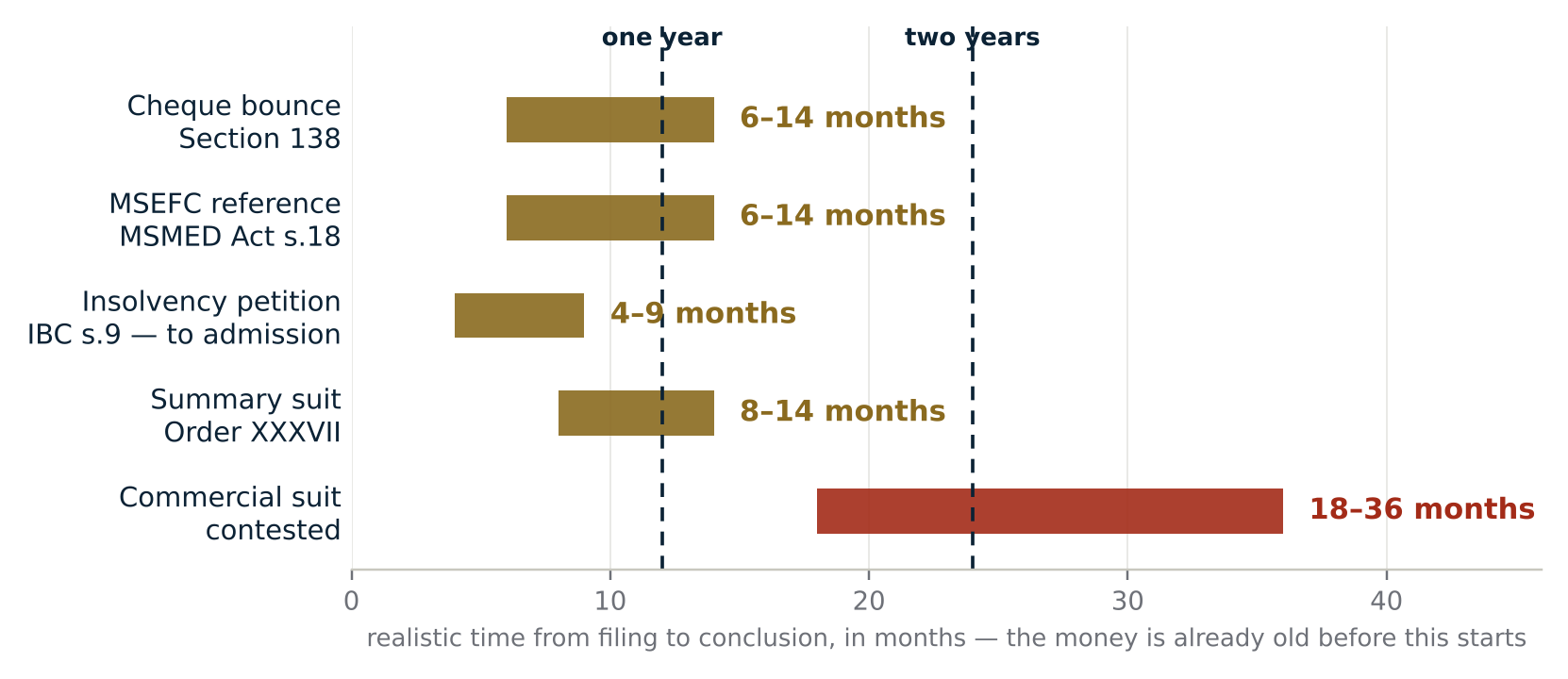
Realistic time from filing to conclusion. The statutory targets are considerably shorter in every case.
| Route | What it needs | Threshold | Realistic time | What it gets you |
|---|---|---|---|---|
| MSEFC reference | Udyam-registered micro or small supplier | None | 6–14 months | An award, with 75% pre-deposit required of the buyer to appeal |
| Cheque bounce, s.138 | A dishonoured cheque, and strict notice timing | None | 6–14 months | A criminal complaint, and interim compensation of up to 20% |
| Summary suit, Order XXXVII | A written contract, bill or acknowledged debt | ₹3 lakh | 8–14 months | A decree, with the buyer needing leave to even defend |
| Commercial suit, contested | Any commercial dispute | ₹3 lakh | 18–36 months | A decree that still has to be executed |
| Insolvency petition, IBC s.9 | Undisputed default, no pre-existing dispute | ₹1 crore | 4–9 months to admission | Admission into a collective process, not your money |
The one worth being careful about
Section 9 of the IBC is the route most often reached for and least often understood. A demand notice gets a buyer's attention in a way little else does, because admission puts their board out of control of their own company.
It works badly as a recovery mechanism, and the courts have said so repeatedly. Insolvency is a collective proceeding, not a debt collection forum. If your petition is actually admitted, you do not get paid — you become one creditor among many in a resolution process, usually recovering less, and far later, than a negotiated settlement would have produced.
Two further limits. The default must be at least ₹1 crore, measured at the date of filing. And a pre-existing dispute — any genuine quality or quantity claim raised before your demand notice — defeats the petition outright. A buyer who has ever written to you complaining about the goods has a defence.
The IBC is a lever. Pulling it all the way is usually the worst outcome available to you, including compared with doing nothing.
The step people forget
For any commercial court claim, pre-institution mediation is mandatory before you can file, unless you are seeking urgent interim relief. It runs three months, extendable by two. The Supreme Court confirmed in 2022 that this is not optional and a suit filed without it is liable to be rejected.
So the 18 to 36 months in the table above does not start when you decide to sue. It starts up to five months later.
The clock that matters more than any of them
A trade debt in India is generally recoverable for three years from the date it fell due. After that it is time-barred, and no forum will help you.
A qualifying written acknowledgement or part payment can start a fresh period under Sections 18 and 19 of the Limitation Act, 1963. A qualifying acknowledgement must recognise the relevant liability in writing and be signed before the applicable period expires by the liable party or its duly authorised agent. A fresh period under Section 18 runs from signing. For Section 19, payment must be made before expiry by the liable party or its duly authorised agent, with acknowledgement of that payment in the payer’s handwriting or in writing signed by the payer. A fresh period runs from payment. A routine ledger confirmation is useful only if it meets the relevant conditions; check the cause of action and dates before relying on it.
The balance confirmation your auditor chases every year is also the document that keeps your claim alive. Nobody files it that way.
The practical consequence is the opposite of what most people assume. The risk is not that you file too late to win. It is that you spend two years not filing, then discover the acknowledgements stopped coming eighteen months ago.
What the ledgers say happens next
Here is the finding that changed how we think about accounts already in legal proceedings.
On one trade channel book, a substantial group of customers had been placed in legal status — notices issued, proceedings filed, the file handed to lawyers and closed as far as the business was concerned. Those accounts were, in the company's own mind, being dealt with.
When somebody went and spoke to them directly, 28 per cent of those customers opened settlement discussions.
More than a quarter of the accounts that had been given to the legal process were willing to negotiate — and nobody had asked them in months.
That number says something uncomfortable about what filing actually achieves inside a company. It does not mainly produce recovery. It produces closure of management attention. The account moves from a live problem to a legal matter, the follow-up stops, and the file ages quietly in a lawyer's office while the business tells itself the matter is in hand.
And the money ages with it. On that same book, balances collected inside the first year returned 35.2 per cent. Beyond five years, 2.4 per cent. A contested commercial suit comfortably outlives the window in which the debt was worth collecting.
When filing is genuinely right
None of this is an argument never to litigate. There are situations where a legal route is clearly the correct decision:
The debt is genuinely disputed — a real quality, quantity or scope disagreement that negotiation has failed to resolve needs an authoritative finding, and only a forum can give you one
The buyer is dissipating assets — where there is reason to believe the counterparty is winding down or moving value, speed and interim relief matter more than cost
You hold a dishonoured cheque — section 138 is cheap, fast by Indian standards, and the criminal element produces settlements that civil proceedings do not
Limitation is about to expire — and no acknowledgement is obtainable. Filing preserves the claim even if you settle afterwards
The relationship is already over — the commercial cost of enforcement is zero if there is no future business to protect. This is the condition most people get wrong in both directions
What to do before you file
In our experience the sequence that recovers the most money is almost the reverse of the instinctive one.
Establish whether it is a dispute or a delay — they need opposite responses and the ageing report cannot tell you which you have. This usually takes days, not months
Complete the file — in a surprising share of cases the money is not refused, it is waiting on a document. Government buyers on complete files settle at 56 days against 173 on incomplete ones
Get the acknowledgement — a signed confirmation protects your position for three more years and costs nothing
Talk to the customer, including the ones already in legal status — 28 per cent of them will talk
Then file, if it is still the right answer — with a decision about which route, taken on the merits rather than on whoever is loudest in the room
Filing is not the end of the collections process. In most companies it is the moment the collections process stops, and that is precisely the problem.
A legal remedy establishes that you are owed money. It does not make anybody pay you. In the overwhelming majority of unpaid Indian trade receivables, nobody was disputing that you were owed the money in the first place.
Use the law where there is a dispute. Everywhere else, use the telephone.
GGA India Private Limited has worked in B2B revenue realization since 2002, across services, trade channel, supply and project credit, with government, institutional, channel and direct B2B buyers.
Author
Gaurav Gupta, Founder and Chief Executive, GGA India Private Limited. Published October 2026.
Basis and source
Engagement figures. That 28 per cent of customers already in legal status opened settlement discussions when approached directly is from a GGA trade channel engagement and is documented in the GGA Trade Channel Receivables Case Study. The recovery yields of 35.2 per cent inside one year and 2.4 per cent beyond five are from a trade channel book worked over five years by the same team. The 173-day and 56-day government comparison is from GGA engagement data across engagements. The underlying analysis is available on request.
Timelines. Realistic rather than statutory, drawn from published practitioner guidance on Indian recovery forums. Statutory targets are considerably shorter in every case — the MSEFC target is 90 days — and the gap between the two is the point of the chart. Timelines vary substantially by state, bench and the conduct of the parties, and any individual matter may fall well outside these ranges.
Legal position. Thresholds and procedure as at the date of writing: the Commercial Courts Act threshold of ₹3 lakh (reduced by notification dated 3 July 2018); mandatory pre-institution mediation under section 12A, held mandatory by the Supreme Court in Patil Automation v. Rakheja Engineers (2022); the IBC minimum default of ₹1 crore (notification dated 24 March 2020), measured at the date of filing; the 75 per cent pre-deposit on challenging an MSEFC award under section 19 of the MSMED Act (new MSME claims are filed on the MSME ODR portal, odr.msme.gov.in; MSME Samadhaan stopped taking new references on 15 October 2025); and interim compensation of up to 20 per cent under section 143A of the Negotiable Instruments Act. Limitation on a trade debt is generally three years under the Limitation Act 1963, with any fresh period from acknowledgement or part payment subject to the timing, party, signature and payment-proof conditions in Sections 18 and 19 described above.
This is not legal advice. GGA is a B2B revenue-realization firm, not a law firm, and nothing here is advice on your matter. Thresholds, procedure and limitation turn on facts specific to each transaction, and the law changes. Take advice from counsel before filing anything or allowing a limitation period to run.
Disclaimer
Published by GGA India Private Limited for general information. It is not legal, tax, accounting or investment advice and does not take account of the circumstances of any particular business. GGA is a B2B revenue-realization firm; it is neither a law firm nor a tax adviser. Figures drawn from client engagements are aggregated and anonymised, and no client is identified. Figures drawn from published company accounts carry their source, population and denominator. Where statutory provisions are described, the position is as at the date of publication and such provisions change. Take your own professional advice before acting.
GGA India Private Limited · Gurugram · gg@ggaindia.co.in · ggaindia.com
Evidence boundary
This publication separates measured findings, modelled illustrations and operating observations. Population evidence does not predict the outcome of an individual receivable, counterparty or company.
Public law, policy terms and procedures can change. Current primary material and the facts of the live case govern.