GGA RESEARCH & PRACTICE
What Engaging a Receivables Partner Actually Involves
What a receivables engagement buys, what the client must provide and what the first 90 days should produce.
Start with what you are buying
There are three different things sold under the same heading, and confusing them is the most common reason an engagement disappoints.
Recovery — somebody works your overdue book and collects what can be collected. Priced on results.
Assurance — somebody works your current book so that invoices are paid on the due date rather than becoming overdue. Often priced on effort. Success commission is based on cash actually received. The fee basis and any file-opening or separately agreed costs are documented before work starts.
Intelligence — somebody tells you which of your customers can pay, which will pay, and which were never going to. Priced as work.
Most companies ask for the first. The second is where the money actually is. And the third is often worth more than either, because it stops the problem recurring.
A firm that only sells recovery has an interest in your book continuing to go bad. Ask what they do about the other two.
How it is priced, and what to watch in each
Three structures are common in India. None is inherently better; each creates a different incentive, and the incentive is the thing to examine.
| Structure | How it works | What it is good for | The incentive it creates |
|---|---|---|---|
| Success fee | A share of what is actually collected. Nothing collected, nothing paid. | Overdue books, where the work is uncertain and the client wants risk transferred. | Pushes effort toward the easiest money. The hard accounts can get quietly deprioritised. |
| Retainer | A fixed monthly fee for a defined scope of work. | Current-book assurance and process work, where there is no recovery to share. | Pays for activity rather than outcome. Needs a defined deliverable or it drifts. |
| Hybrid | A modest retainer plus a success element. | Mixed engagements, and long books where early work has no immediate yield. | Balanced, but only if the retainer is small enough to keep the outcome mattering. |
On a success fee, the single most important question is not the percentage. It is what happens to the accounts that cannot be collected. A book always contains some. If the answer is that they are simply left, you are paying for the easy half of your problem and keeping the hard half, which is the half that was costing you money.
Two things that should make you cautious
A recovery percentage quoted before anybody has seen your ledger. Nobody can know what is recoverable from a book they have not looked at. A firm that promises a number up front is either guessing or selecting what they tell you. Recovery depends almost entirely on the age and composition of the book, and those are facts about you, not about them.
A reluctance to say what they will not do. Ask directly: which accounts will you hand back, and when? A partner who claims they work everything equally is describing a business that does not exist.
What you actually have to hand over
This is the part that stalls most engagements, and it is almost always underestimated. The list is short but the work is real:
The ledger, at invoice level — not a summary and not an ageing bucket. Invoice number, date, amount, due date, customer, and what has been received against it.
Customer contact detail that is current — the single most common blocker in the first month. The name in your system left two years ago.
Supporting documents — purchase orders, proof of delivery, acceptance, certification where relevant. The documents are the collection in a surprising share of cases.
Credit and dispute history — what was agreed, what was argued about, what was settled. Without it your partner will reopen issues you had already closed.
A named person on your side — who can answer a question within a day. Not a committee.
If getting that together feels like a project, that is itself the diagnosis. A book you cannot describe is a book nobody has been working.
What the first ninety days actually look like
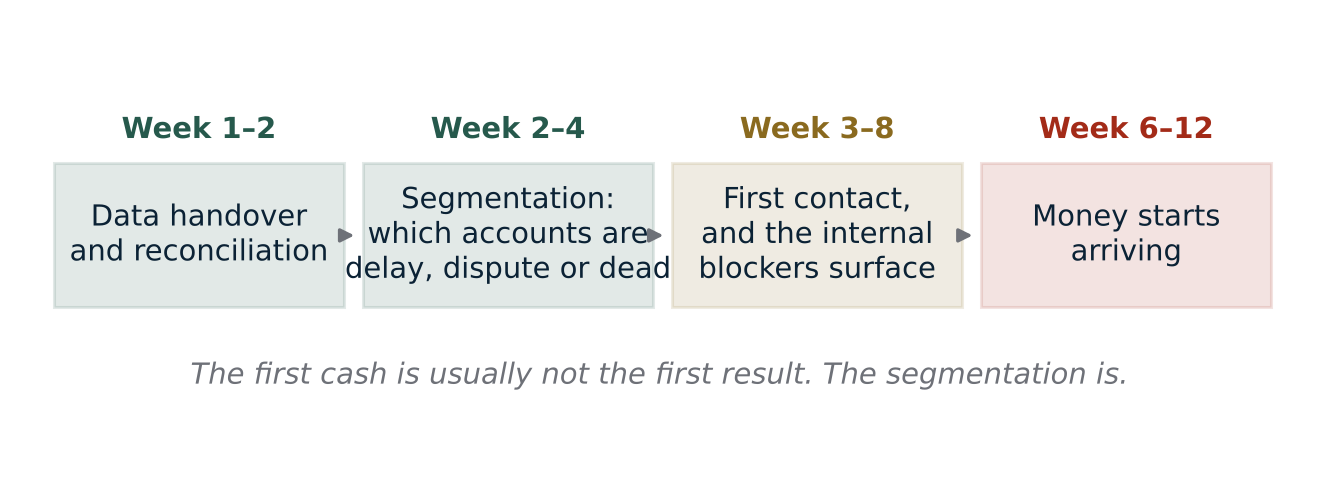
The sequence matters, and the first useful output is not money.
In the first weeks the book is reconciled and segmented: which balances are a simple delay, which sit behind a dispute, and which have no collectable counterparty at all. That third category is routinely larger than management expects. On one trade channel book, 61 per cent of the overdue value turned out to need risk, commercial or service resolution rather than collections follow-up — shuttered shops, dissolved partnerships, unresolved claims. Recovery on that book reached 27 per cent in six months, and the segmentation was worth more than the cash, because the company had been carrying the other 61 per cent as an asset and directing sales effort at customers who could not pay under any circumstances.
Then the internal blockers surface, and this is the part clients find uncomfortable. Across fifteen GGA engagements, the majority of blocked value needed somebody inside the seller to act — 78 per cent on a logistics book, 61 per cent on an equipment maintenance book. Your partner cannot fix those. They can only tell you they exist and wait.
In GGA's engagements, cash usually begins arriving between weeks six and twelve. On an aged book it begins later and amounts to less, which is arithmetic rather than performance: on one distressed trade channel book worked over five years, balances worked inside their first year returned around 35 per cent, beyond five years around 2 per cent.
What it does to the sales relationship
This is the real objection, and it is usually unspoken. The fear is that a third party will damage accounts the sales team has spent years building.
It is a legitimate concern and the answer is structural rather than reassuring. A separate function protects the relationship, because it removes the conflict rather than creating one. Your salesperson currently has to ask for the next order and demand the last payment in the same conversation. Giving the second job to someone else is what lets them keep doing the first.
What genuinely does damage relationships is an aggressive consumer-style collection approach applied to a B2B account that intends to keep buying. Ask how the firm segments by relationship value, and what the escalation ladder looks like. If the answer is the same for a strategic customer and a dead one, that is the wrong firm.
When you should not do this
Four situations where engaging anyone is the wrong move, and saying so costs us work:
Your book is clean and current — if the overwhelming majority of invoices are paid inside terms, you do not have a receivables problem and you will not get a return. Spend the money elsewhere.
The problem is entirely internal — if invoices are going out wrong, documentation is incomplete and acceptance is never confirmed, no external party can collect your way out of it. Fix the process first, or the same book regenerates.
You are not prepared to act on what you are told — a diagnostic that identifies a customer who should be stopped is worthless if nobody will stop supplying them. This is the most common reason engagements fail, and it is not the partner's fault.
You want somebody to blame — outsourcing does not transfer the problem. It transfers the work. The decisions stay with you.
If you are expecting an external firm to fix a book while nothing changes internally, you will get the easy money and the same problem again next year.
Questions worth asking anyone, including us
What will you tell me in the first thirty days that I do not already know? — if the answer is only an ageing report, you already have one.
Which accounts will you hand back, and on what trigger? — tests whether they have a real method or an open-ended effort.
How much of my problem will turn out to be mine to fix? — a firm that says none has not worked many books.
Who actually makes the calls, and what are they told to do when a customer disputes? — the answer tells you whether you are buying a process or a call centre.
What does this look like after the overdue book is cleared? — the real question. A one-off recovery leaves you where you started; the point is not having the book again.
Engaging a receivables partner is not handing over a problem. It is buying a function you do not have, accepting that part of what it finds will be about your own process, and acting on that. Firms that tell you otherwise are selling you the easy half.
Ask what they will hand back. The answer tells you everything else.
GGA India Private Limited has worked in B2B revenue realization since 2002, across services, trade channel, supply and project credit, with government, institutional, channel and direct B2B buyers.
Author
Gaurav Gupta, Founder and Chief Executive, GGA India Private Limited. Published October 2026.
Basis and source
Engagement figures. The 61 per cent requiring resolution beyond collections and the 27 per cent recovered in six months are from a GGA trade channel engagement, documented in the GGA Trade Channel Receivables Case Study. The 78 per cent and 61 per cent internally-owned blocked value are from a logistics and an equipment maintenance engagement, documented in the GGA Internal Blockers Evidence Paper. The recovery yields by age of balance are from a trade channel book worked over five years by the same team. The underlying analysis is available on request.
Fee structures. Described as structures and incentives rather than as market rates. GGA has not surveyed Indian commission levels. Success commission is based on cash actually received. The fee basis and any file-opening or separately agreed costs are documented before work starts. GST extra.
Declared interest. GGA sells B2B revenue-realization services, so this article is written by an interested party. It is published because the questions in it are the ones a buyer should ask, and they are questions GGA is willing to be asked. The section on when not to engage is included for the same reason.
Timelines. The ninety-day sequence describes the typical shape of a GGA engagement and is drawn from operating experience rather than from a measured dataset. Individual engagements vary considerably with the state of the ledger at handover.
Disclaimer
Published by GGA India Private Limited for general information. It is not legal, tax, accounting or investment advice and does not take account of the circumstances of any particular business. GGA is a B2B revenue-realization firm; it is neither a law firm nor a tax adviser. Figures drawn from client engagements are aggregated and anonymised, and no client is identified. Figures drawn from published company accounts carry their source, population and denominator. Where statutory provisions are described, the position is as at the date of publication and such provisions change. Take your own professional advice before acting.
GGA India Private Limited · Gurugram · gg@ggaindia.co.in · ggaindia.com
Evidence boundary
This publication separates measured findings, modelled illustrations and operating observations. Population evidence does not predict the outcome of an individual receivable, counterparty or company.
Public law, policy terms and procedures can change. Current primary material and the facts of the live case govern.