GGA RESEARCH & PRACTICE
Credit Insurance Covers the Loss. It Does Not Collect the Money.
Why insurance and active receivables management solve different parts of export and domestic payment risk.
What it actually is
Two products sit under this heading in India, and they work the same way.
Export credit insurance, principally from ECGC, covers an exporter against not being paid by an overseas buyer — both commercial risk, meaning the buyer's insolvency or default, and political risk, meaning war, import restrictions or a transfer block in the buyer's country. For small exporters, cover of up to 90 per cent is available.
Domestic credit insurance, available from ECGC and from private insurers, does the same for sales within India. Under ECGC's domestic policy, cover is 90 per cent under a turnover policy and 80 per cent under other policies.
Both are insurance against loss. Neither is a collection service, and the distinction is where most of the disappointment comes from.
The three gates between your invoice and a claim
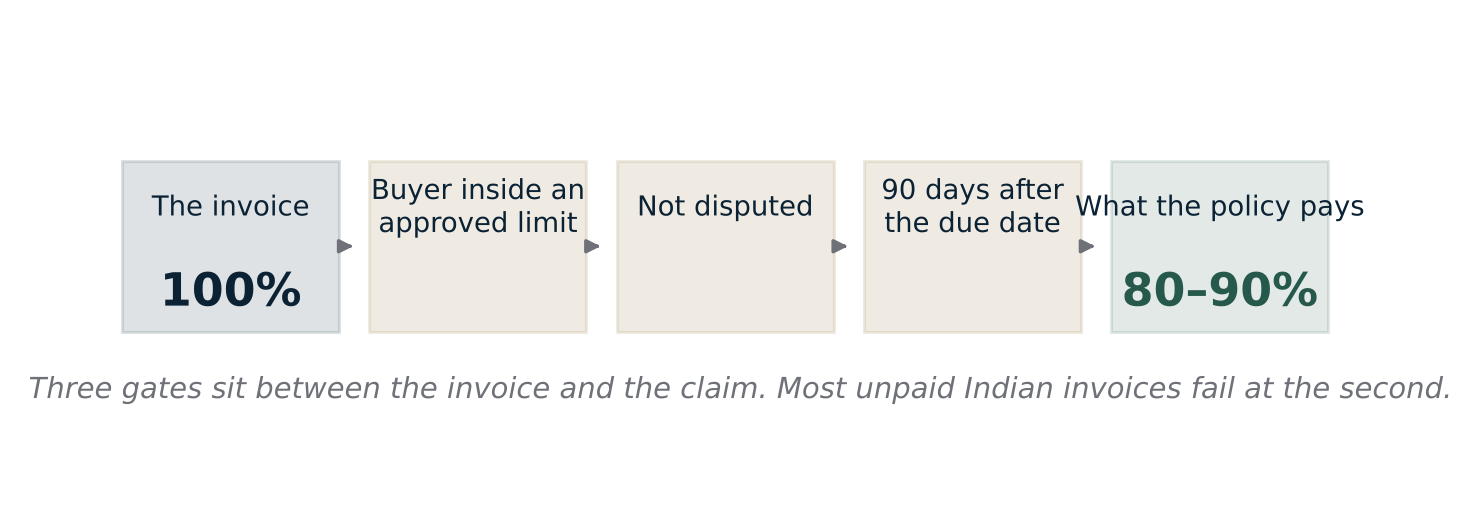
A claim is not triggered by an invoice going unpaid. It is triggered by an unpaid invoice that clears three conditions.
The buyer must be inside an approved credit limit — either a specific limit approved by the insurer for that buyer, or a discretionary limit you can apply yourself where you hold a credit agency report, a banker's reference of at least double the credit extended, or a clean trading history with nothing unpaid beyond 30 days past due. Sell outside the limit and that exposure is uninsured.
The debt must not be disputed — cover is for insolvency and for wilful or protracted default. Where the buyer has raised a quality or quantity claim, you do not have an insured default; you have a commercial dispute, and that is outside the policy until it is resolved.
Ninety days must pass — under the domestic policy, loss on protracted default is ascertained 90 days after the due date. The waiting period is the point at which you can begin, not the point at which you are paid.
Cover is 80 to 90 per cent, of an approved exposure, that is not in dispute, ninety days after the money was due. Every one of those qualifiers removes a slice of a real Indian receivables book.
The clause almost nobody reads
Here is the part that decides whether insurance and collections are alternatives or partners.
Under the policy the insured must take all steps which may be necessary or expedient, or which the insurer may require, to effect recoveries — including legal proceedings. And once a claim is paid, your rights under the contract are assigned to the insurer.
Read that plainly: the policy does not relieve you of the obligation to pursue the money. It requires you to pursue it. An insurer is underwriting a seller who runs a competent collections process, and the policy says so in writing.
Credit insurance does not replace a collections function. It assumes you have one.
Which also means the two are not competing purchases. A business with good collections and no insurance is exposed to the customer who genuinely fails. A business with insurance and no collections will discover that most of its unpaid book never reaches a claim, because it is disputed, outside limit, or simply not yet ninety days old and drifting.
What it does not cover, and why that matters here
Set against what actually blocks Indian trade receivables, the gap is specific.
Across fifteen GGA engagements, the majority of blocked value required somebody inside the seller to act — 78 per cent of blocked value on a logistics book, 61 per cent on an equipment maintenance book. On a technology services book, 38.5 per cent of the opening balance could not have been collected by anyone until the seller fixed it first. Missing documentation, unconfirmed acceptance, unresolved claims, incomplete files.
None of that is an insured event. The buyer is solvent and has not defaulted; the invoice is simply not payable yet, because something on your side is incomplete. No policy pays for that, and no policy ever will.
The same is true of the government buyer taking 173 days on an incomplete file. That is not default. It is a file with a gap in it, and the remedy is to complete the file — which is why the same engagements show government and private buyers both settling at 56 days once it is complete.
When credit insurance is clearly the right purchase
You export, and you are not insured — this is the straightforward case. Political risk alone justifies it, you cannot diligence a foreign buyer the way you can an Indian one, and for small exporters the cover is substantial.
Your book is concentrated — where the loss of one or two customers would be material rather than painful, you are carrying a risk you cannot absorb. That is precisely what insurance is for.
You are entering a new segment or geography — where you have no trading history to price the risk from, the insurer's credit limit decision is itself useful information — arguably more useful than the cover.
Your lender wants it — insured receivables borrow better, and the financing benefit is sometimes larger than the premium.
And one case where it is the wrong purchase: buying cover in the hope that it will deal with a book that is already overdue. Insurance prices future risk. It does nothing about the money already sitting past six months, and the insurer will decline to cover exposures you are already struggling with.
How to hold both
If you do buy cover, three practices make it work rather than sit in a drawer.
Treat the credit limit as a selling rule, not a filing requirement — the limit is the insurer's view of what that buyer can safely owe. Exceeding it is a decision to go uninsured, and it is usually taken by somebody in sales who has never seen the policy.
Diarise the waiting period from the due date, not from when somebody notices — ninety days is a deadline for you as much as a delay. Claims are lost to late notification far more often than to refusal.
Keep collecting throughout — because the policy requires it, because a settled account beats an 80 per cent claim, and because the insurer will ask what you did.
Credit insurance answers the question of what happens if a customer cannot pay. It has nothing to say about the far more common situation, which is a customer who has not paid, is not disputing anything, and is waiting for somebody to complete the file and ask.
Insure the risk you cannot control. Work the one you can.
GGA India Private Limited has worked in B2B revenue realization since 2002, across services, trade channel, supply and project credit, with government, institutional, channel and direct B2B buyers.
Author
Gaurav Gupta, Founder and Chief Executive, GGA India Private Limited. Published October 2026.
Basis and source
Policy terms. Cover percentages, covered risks, the ninety-day waiting period on protracted default, the discretionary and specific credit limit requirements, and the obligation on the insured to pursue recovery and assign rights after a claim are taken from ECGC's published Domestic Credit Insurance Policy literature. The reference to enhanced cover of up to 90 per cent for small exporters is from ECGC's published announcements. Terms vary between policies, between insurers and over time, and your own policy wording governs.
Engagement figures. The 78 per cent, 61 per cent and 38.5 per cent of blocked value requiring internal action are from GGA engagements, documented in the GGA Internal Blockers Evidence Paper and the GGA Technology Services Receivables Case Study. The 173-day and 56-day government comparison is from GGA engagement data across engagements. The underlying analysis is available on request.
Declared interest. GGA sells B2B revenue-realization services and does not sell insurance, receive commission on it, or act as a broker. This article argues that the two are complements rather than substitutes, which is a position favourable to GGA; it is stated so the reader can weigh it.
Not advice. This is general information about how these products work, not advice on whether to buy one or on any particular policy. Credit insurance is a regulated product and the terms that matter are the ones in your own policy schedule. Take advice from your insurer or broker.
Disclaimer
Published by GGA India Private Limited for general information. It is not legal, tax, accounting or investment advice and does not take account of the circumstances of any particular business. GGA is a B2B revenue-realization firm; it is neither a law firm nor a tax adviser. Figures drawn from client engagements are aggregated and anonymised, and no client is identified. Figures drawn from published company accounts carry their source, population and denominator. Where statutory provisions are described, the position is as at the date of publication and such provisions change. Take your own professional advice before acting.
GGA India Private Limited · Gurugram · gg@ggaindia.co.in · ggaindia.com
Evidence boundary
This publication separates measured findings, modelled illustrations and operating observations. Population evidence does not predict the outcome of an individual receivable, counterparty or company.
Public law, policy terms and procedures can change. Current primary material and the facts of the live case govern.