GGA RESEARCH & PRACTICE
The 45-Day Rule and What It Actually Changed
A company-level study of India’s MSME payment rule, its tax consequence and the limits of what annual accounts can prove.
What the law says
For a qualifying micro or small supplier, Section 15 requires payment by the agreed written date, which cannot be later than 45 days from acceptance or deemed acceptance. Without a written payment agreement, payment is due before the appointed day: the day immediately after 15 days have expired from acceptance or deemed acceptance. Record any timely written objection because it can affect the acceptance date. Check supplier eligibility and the actual invoice facts.
What changed in 2024 is the consequence. Section 43B(h) of the Income-tax Act made payment a condition of the tax deduction. Miss the deadline and the amount is added back to your taxable income for that year; you get the deduction only in the year you actually pay.
And unlike every other item in section 43B, you cannot rescue it by paying before you file. For provident fund, for bonus, for interest to a bank, paying before the return due date preserves the deduction. For MSME dues it does not. If the money has not moved by 31 March, the deduction is gone for that year.
That carve-out is the part most people get wrong, and it is the part that costs money.
The rule is not really about 45 days. It is about 31 March. An unpaid expense within the applicable payment deadline is not automatically disallowed merely because it is outstanding on 31 March. Apply the statutory due date and actual-payment rule to each qualifying amount.
Where the rule now lives
Section 43B(h) was inserted by the Finance Act 2023 and first applied to FY 2023-24. It governs every year up to and including FY 2025-26.
From FY 2026-27 the Income-tax Act 2025 is in force, and the same provision now sits at section 37(2)(g). The substance is unchanged, including the carve-out: section 37(3) again excludes it from the pay-before-filing rescue.
So for the audit you are completing now, cite 43B(h). For the year you are currently trading in, cite 37(2)(g). They do the same thing.
What it actually changed
Everyone has written about what the rule requires. Nobody has published what it did. So we measured it.
We took 6,132 Indian companies with four consecutive years of accounts spanning the change, split them by turnover, and compared the collection period in the year before the rule against the two years after it. The study uses turnover up to ₹50 crore as its historical smaller-company proxy and larger companies as a comparison group. Turnover alone does not establish legal micro or small status: investment, registration and the thresholds applicable at the relevant date must also be checked.
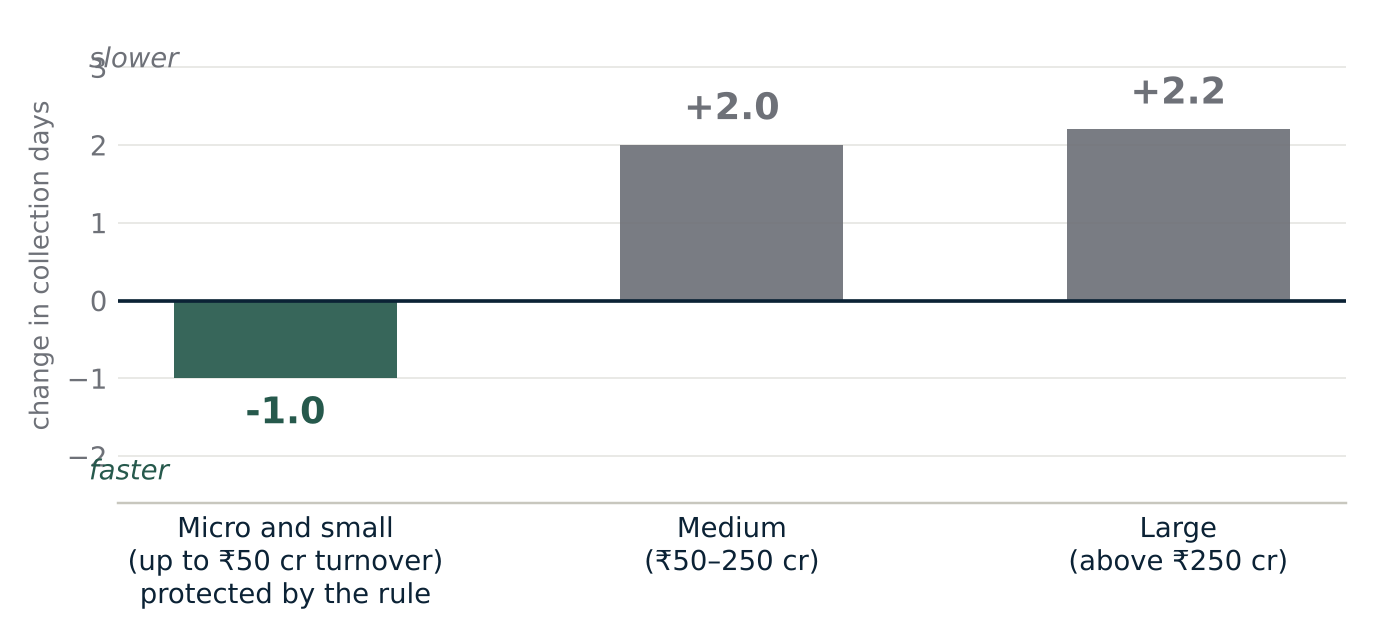
Change in median collection period, before the rule against after it, by size of supplier.
Protected suppliers improved by 1.0 days. Everybody else got worse: medium companies slipped 2.0 days, large companies 2.2.
That is the finding, and it is not the one anybody expects. The rule did not make buyers pay small suppliers faster. Over these years payment terms were lengthening across the Indian economy. What the rule did was hold small suppliers roughly still while everyone without that protection was carried along with the drift.
The gap between protected and unprotected suppliers is 3.2 days. Not because one group sped up, but because the other slowed down.
The difference is statistically solid rather than noise. It is also, measured against a problem of 67 days, very small.
And here is the number that matters
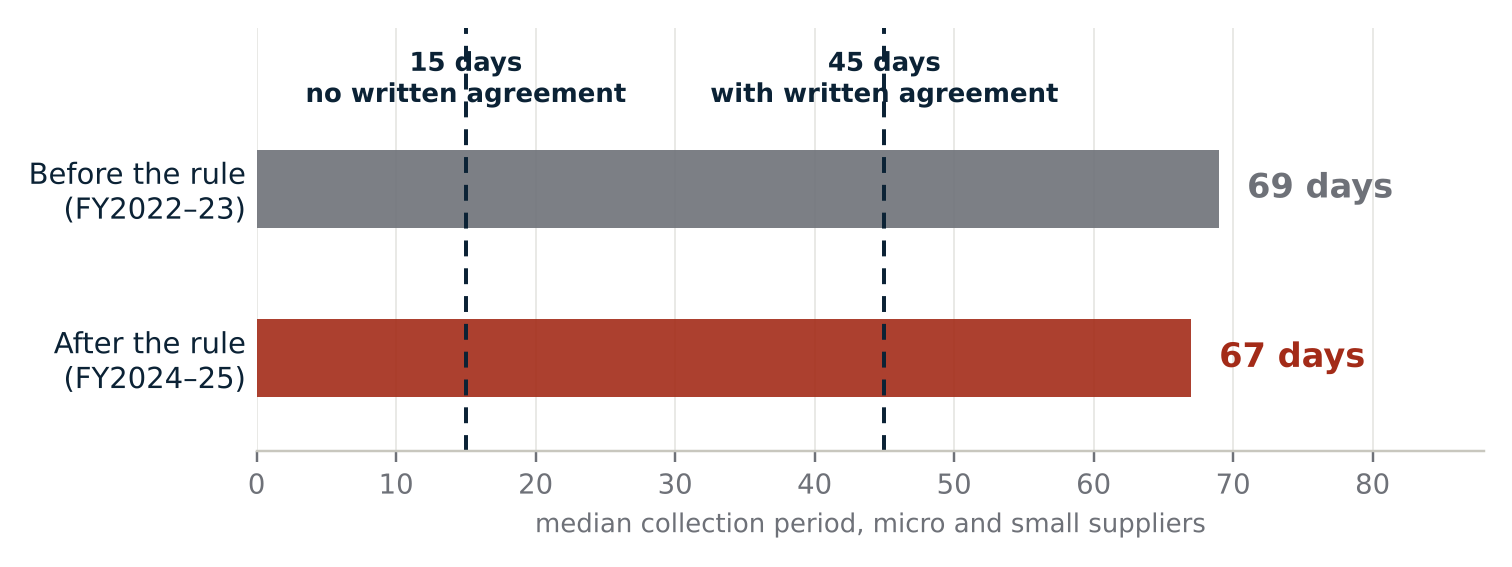
Median collection period for micro and small suppliers, against the two statutory deadlines.
Before the rule, the median micro or small supplier waited 69 days. After it, 67 days. The statutory maximum is 45. Where there is no written agreement, it is 15.
The median protected supplier in India is paid 22 days beyond the legal limit — and that is after the improvement. At the upper quartile the wait is 111 days. At the ninetieth percentile, 194.
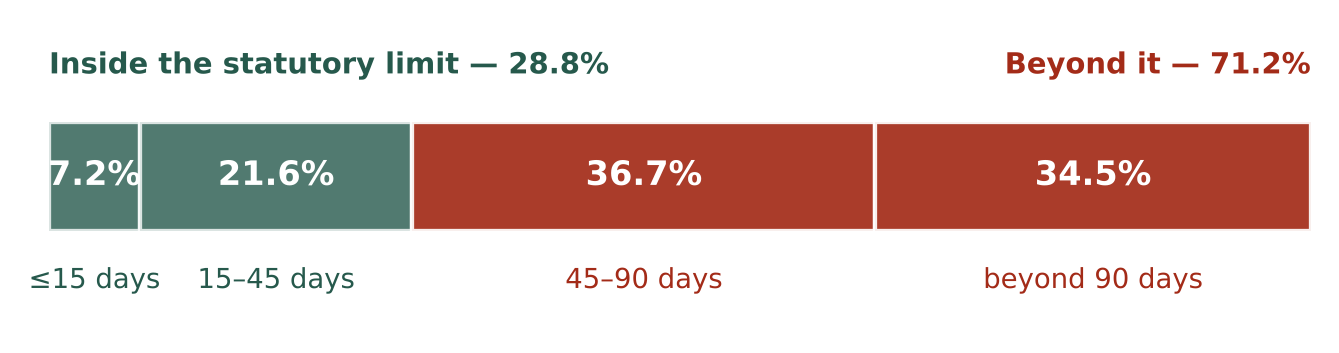
Micro and small suppliers by how long they actually wait, after the rule took effect.
71.2 per cent are still paid beyond 45 days. More than a third wait beyond ninety. Fewer than one in thirteen is paid inside the fifteen-day limit that applies when no written agreement exists.
And compliance did not improve at all. Before the rule, 70.1 per cent of micro and small suppliers were paid beyond 45 days. After it, 71.2 per cent. Slightly more are paid late now than before the law existed.
A statute backed by the income tax department, aimed at the largest buyers in the country, did not raise compliance by a single point. It is worth asking why.
Why so little moved
The first reason is not in any commentary on this section, and it undoes most of the rest.
A great many small suppliers never tell their customer they are an MSME.
The buyer's obligation only bites if the supplier is classified micro or small under the Udyam notification. In practice the buyer learns that from the supplier — the registration number on the invoice, the certificate submitted at vendor onboarding. And a large number of small suppliers deliberately do not provide it.
The reason is commercial and entirely rational. Declaring MSME status puts the customer on a 45-day clock backed by a tax penalty. Some buyers respond by paying faster. Others respond by deprioritising that vendor at the next tender, trimming the order, or quietly moving the volume to a supplier who creates no such exposure. A supplier dependent on one large customer for a third of their turnover will not risk that for interest they were never going to claim.
So the protection is, in practice, opt-in — and it requires the beneficiary to identify themselves to the party it penalises. That is a structural weakness no amount of enforcement fixes, and it is the most likely reason the measured effect is three days rather than thirty.
It also means our own number understates the law. If a material share of covered suppliers never declared their status, the 1.0 days is averaged across suppliers the rule actually reached and suppliers it never touched. Among those who did declare, the effect is probably larger. We cannot measure that split, and we are not going to pretend otherwise.
And declaration is only half of it. Among suppliers who are registered, and who do put the number on the invoice, almost none then insist. The interest under section 16 accrues automatically from the appointed day — it does not need a demand, a notice or a clause in the contract. It is simply there, compounding monthly, on a very large share of Indian trade receivables. It is also almost never claimed.
A statutory right you will never exercise against your largest customer is not leverage. It is paperwork.
Three further reasons sit underneath both.
Buyers often do not know which suppliers qualify — even where status has been declared, it sits in a vendor master field that accounts payable has never been asked to maintain. You cannot run a 45-day clock you have not set up.
The penalty lands eleven months late — the disallowance surfaces at tax audit, long after the payment decision was taken by somebody who will never see the assessment.
It is cheaper to be late — the statutory interest is real but small against a stretched payable. At the current bank rate, 23 days late costs roughly one per cent of the invoice. Holding the money is worth more than that to a buyer under working capital pressure.
None of this is an argument against the law. It is an argument about what a law can do. Section 43B(h) changed the price of paying late. It did not change the process that produces late payment, and it cannot compel a supplier to invoke it.
Even the government defaults
The obvious objection to everything above is that it describes private buyers behaving commercially. Government is bound by the same section 15 — departments, central and state undertakings, and public sector buyers are all buyers under the MSMED Act, and several procurement frameworks restate the 45-day obligation explicitly.
It does not hold. Across GGA engagements, government buyers on unmanaged books took 173 days against 63 days for private buyers — nearly three times as long, from the party with the clearest statutory obligation and the least excuse.
But the same data contains the correction, and it is the most useful thing in this article.
On books where the file was complete, government and private buyers both settled at 56 days.
Government is not structurally slow. It is slow when something is missing — a certification, an inspection report, a sanction reference, a signature on a measurement book — and nobody on the supplier's side is present to find out what. The delay is not a decision anybody took. It is a file sitting at a desk with a gap in it.
One GGA engagement supplying diagnostic test kits into central government procurement ran ten months in which nothing moved at all. Once the file was completed, ₹4.84 crore was released in a single day. The money had never been refused. It had never even been disputed. It was waiting for a document, and for somebody to establish which one.
Which is also why no supplier invokes section 16 against a government department. The interest is legally due and the arithmetic is not small. The empanelment is worth more. So the right goes unexercised, the file stays incomplete, and the 173 days become normal.
If you are the supplier
The rule gives you three things you did not have, and most small suppliers use none of them.
A deadline that is not negotiable — your customer's purchase terms do not override section 15. A contract saying 90 days is void beyond 45 to the extent it conflicts.
Interest that accrues automatically — compound interest with monthly rests at three times the RBI bank rate, running from the appointed day without you having to ask. At the present bank rate that is 16.5 per cent a year.
A forum that does not require a civil suit — the MSEFC route under the MSMED Act. New claims are filed on the MSME ODR portal (odr.msme.gov.in); MSME Samadhaan stopped taking new references on 15 October 2025. It is not fast, but it is far cheaper than litigation and it carries a pre-deposit requirement that makes appeals expensive for the buyer.
But use them with your eyes open. Three conditions decide whether any of it applies to you: you must be Udyam registered, you must be micro or small — medium enterprises get nothing here — and you must be supplying goods or services rather than trading. Pure wholesale and retail trading sits outside the delayed-payment protection, notwithstanding that traders have been allowed on the Udyam portal since 2021.
And there is a fourth condition nobody writes down: the buyer has to know. If your Udyam number is not on the invoice and your certificate is not in their vendor master, the clock never starts, the interest never accrues, and the disallowance never arises. The protection is not automatic in practice, however automatic it is in law.
Which is the real decision in front of most small suppliers, and it is not a legal one. Declaring your status starts a clock on your customer. It may also start a conversation you did not want about whether you remain on the panel.
That calculation is yours to make, and it is legitimate either way. But make it deliberately, customer by customer, rather than by default across the whole book. A customer who depends on your product will not drop you for asserting a statutory right. A customer for whom you are one of six interchangeable vendors might. Those are different decisions and most suppliers take neither — they simply never submit the certificate to anyone.
If you are the buyer
Your exposure is not the interest. It is the disallowance, and it is larger than most finance teams have calculated.
Every rupee outstanding to a micro or small supplier on 31 March is added to taxable income. Not deferred to when you pay — taxed now, deducted later. On a ₹5 crore MSME payable sitting past its deadline at year end, at 25 per cent, that is ₹1.25 crore of tax brought forward on money you have not spent.
And there is no fix in March. By then the deadline has passed on everything that was going to breach it, and the pay-before-filing rescue does not apply.
The only thing that works is knowing, in advance and continuously, which of your suppliers are Udyam-classified micro or small, and running their invoices on a separate clock. Most accounts payable systems do not have that field populated. That is the actual project, and it takes a quarter.
What this says about receivables generally
The 45-day rule is the strongest intervention Indian policy has made on payment behaviour. It attached a tax cost to late payment, aimed it at the buyers with the most to lose, and gave the supplier automatic interest and a forum.
It did not raise compliance at all. It slowed a deterioration.
If a statute backed by the income tax department could not do more than that, the conclusion is not that nothing works. It is that payment behaviour is not primarily a legal problem. The invoice that waits 67 days is usually not waiting because the buyer weighed the penalty and chose to breach. It is waiting because nobody confirmed it was accepted, nobody followed it up before the due date, and nobody was present when the payment run was decided. That is also exactly what the government figures show: when the file was complete, the same buyers paid in 56 days.
The law gave small suppliers a right. It did not give them a process. Seven in ten are still paid late because the thing that gets an invoice paid was never a deadline — it is somebody following it, every day, until the money arrives.
A right you do not enforce is a number on a statute. Follow-through is what turns it into cash.
GGA India Private Limited has worked in B2B revenue realization since 2002, across services, trade channel, supply and project credit, with government, institutional, channel and direct B2B buyers.
Author
Gaurav Gupta, Founder and Chief Executive, GGA India Private Limited. Published October 2026.
Basis and source
What was measured. Collection period is computed as average trade debtors — the mean of the opening and closing balance — divided by annual sales turnover, multiplied by 365. This is the basis used across all GGA benchmark work because it reproduces ACE Equity's own published receivable-days field exactly, at a correlation of 1.0000 and a median difference of 0.0 days; closing debtors alone differs by a median of 6.1 days and is not used. Each company's figure for the year before the rule (the year ended March 2023) is compared against the mean of the two years after it (March 2024 and March 2025), aligned on actual financial year rather than on position in the extract. Values outside 1 to 730 days are treated as unusable.
Who is in the figures. 6,132 Indian companies with a usable collection period in the year ended March 2023 and in both of the two years after it, drawn from the trade-credit population used across GGA's research: companies selling goods and services to other businesses on terms, after removing state-owned companies, banks and finance, IT and BPO, healthcare, telecom services, power, refineries, diamond and jewellery, airlines, education, real estate, and retail and hospitality. Records where debtors exceed three times sales in any year are dropped as misfiled.
How suppliers were classified. By turnover averaged over the two pre-rule years, so that classification cannot be affected by anything that happened afterwards. Companies up to ₹50 crore are treated as micro or small, ₹50–250 crore as medium, above ₹250 crore as large.
The most important limitation. Turnover is a proxy. The statutory definition also tests investment in plant and machinery, and the protection applies only to suppliers actually registered on Udyam. Some companies in the protected group will not qualify, and some will not have registered. The measured effect is therefore a lower bound on the effect among genuinely covered suppliers, not a precise estimate of it. The difference between the protected and large groups is significant on a Mann-Whitney test at p below 0.0000001. Excluding companies below ₹5 crore of turnover, the protected group changes by only 0.2 days rather than 1.0, so the absolute improvement is concentrated in the smallest companies; the gap against large companies remains at 2.4 days. Both figures are reported because the second is the more conservative reading.
The non-declaration point. That many small suppliers withhold their MSME status from customers is observed from GGA engagement experience across sectors, not measured from this dataset. Nothing in published accounts records whether a supplier declared Udyam status to a given buyer. It is offered as the explanation most consistent with the measured result, and it carries the implication stated in the article: the effect among suppliers who did declare is likely larger than the figure reported here.
What this is not. A difference in collection days between two groups over a period in which one became subject to a new rule. Other things changed in those years for companies of different sizes, and this analysis does not control for them. It is evidence consistent with the rule having a small effect, not proof that the rule caused it.
Engagement figures. The 173-day and 63-day comparison, the 56-day figure on complete files, and the ₹4.84 crore release are from GGA engagement data across engagements, not from the ACE Equity extract. They are documented in the GGA Indian B2B Payment Benchmark and the GGA Government Diagnostics Receivables Case Study. The underlying analysis is available on request.
Source. ACE Equity, the corporate financial database of Accord Fintech Private Limited, Mumbai, compiled from company filings and published financial statements; company-year extracts covering the years ended March 2020 to March 2026. The collection-period basis was validated against ACE Equity's own published receivable-days field across 70,609 company-years: average debtors reproduces it at a correlation of 1.0000 with a median difference of 0.00 days, and 99.9 per cent of observations within one day. All computation and interpretation are GGA's own. Accord Fintech has not reviewed or endorsed the analysis or the conclusions.
Legal position. Section 43B(h) was inserted by the Finance Act 2023 with effect from 1 April 2024, first applying to FY 2023-24, and governs up to FY 2025-26. From FY 2026-27 the equivalent provision is section 37(2)(g) of the Income-tax Act 2025, with the same exclusion from the pay-before-filing proviso. Payment deadlines and interest are set by sections 15 and 16 of the MSMED Act 2006. The bank rate used in the interest illustration is 5.50 per cent. This article is general information about how these provisions bear on cash collection. It is not tax or legal advice, and GGA is neither a tax adviser nor a law firm. Confirm your own position with your auditor or counsel.
Disclaimer
Published by GGA India Private Limited for general information. It is not legal, tax, accounting or investment advice and does not take account of the circumstances of any particular business. GGA is a B2B revenue-realization firm; it is neither a law firm nor a tax adviser. Figures drawn from client engagements are aggregated and anonymised, and no client is identified. Figures drawn from published company accounts carry their source, population and denominator. Where statutory provisions are described, the position is as at the date of publication and such provisions change. Take your own professional advice before acting.
GGA India Private Limited · Gurugram · gg@ggaindia.co.in · ggaindia.com
Evidence boundary
This publication separates measured findings, modelled illustrations and operating observations. Population evidence does not predict the outcome of an individual receivable, counterparty or company.
Public law, policy terms and procedures can change. Current primary material and the facts of the live case govern.