Italian Companies Exporting to India
General information, not legal or financial advice. Terms of Use.
On this page
- Sector 1 · Machine tools and industrial…
- Sector 2 · Textile, garment and leather…
- Sector 3 · Packaging, bottling and food…
- Sector 4 · Specialty chemicals, marble and stone
- Sector 5 · Fashion, leather goods and branded…
- The Italian exporter's contract for India
- If it has already gone wrong
- Questions Italian credit and legal teams ask
- What this guide cannot tell you
- Verification log
Sector by sector — because Italian exposure to India is concentrated, and each concentration fails in its own way
Italian exports to India are not spread evenly across the economy. They cluster: machine tools and industrial automation, textile and garment machinery, packaging and bottling lines, food processing plant, leather and tanning machinery, specialty chemicals, marble and stone processing equipment, and fashion and leather goods. Each of these sits with a different kind of Indian buyer, on different terms, and produces a different kind of failure.
Before the sectors, one structural fact that applies to all of them.
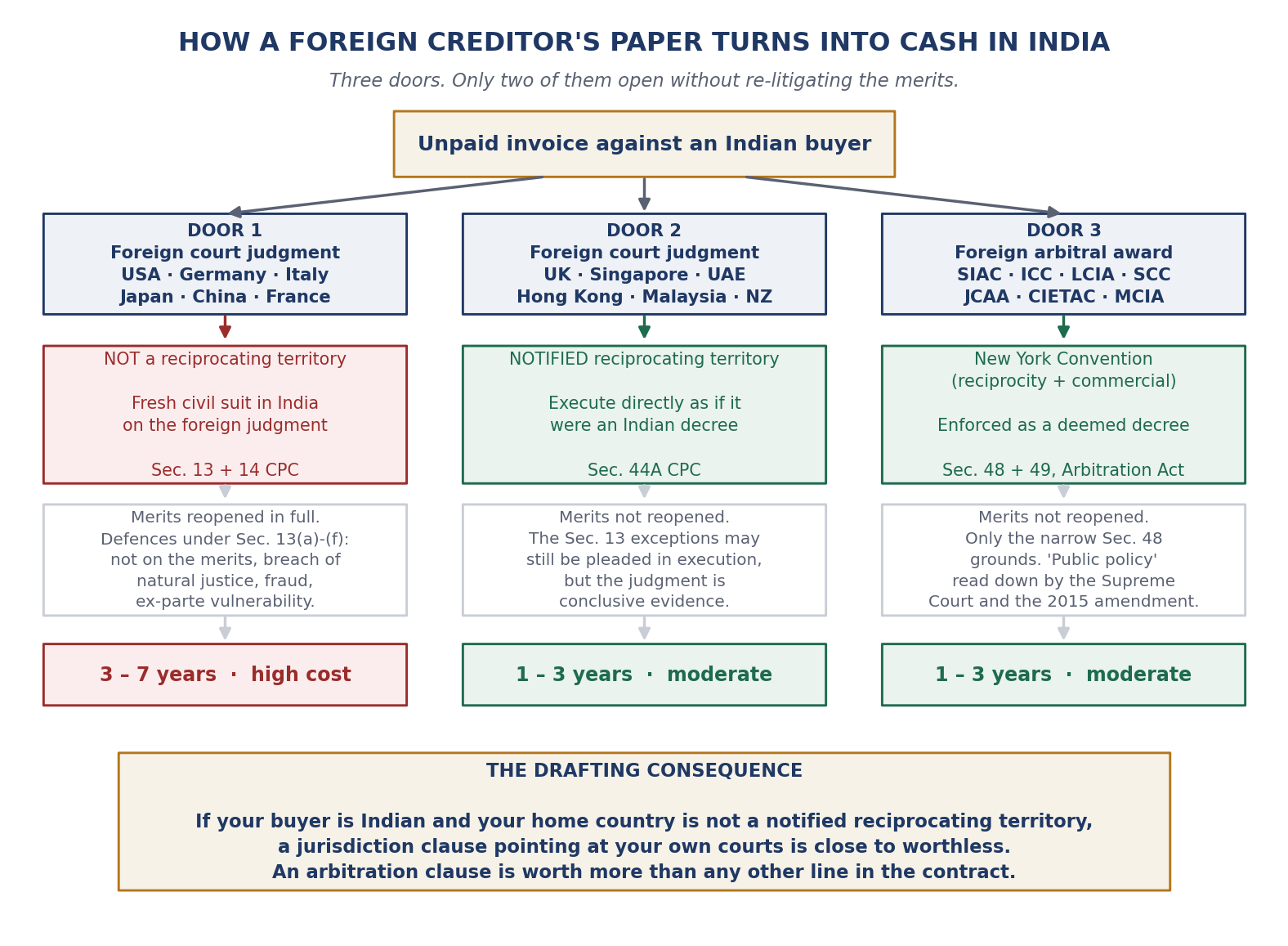
The same asymmetry applies to expectations built on Legislative Decree 231/2002 and the EU Late Payment Directive: statutory interest and the fixed recovery cost bind within the Union and have no application to a buyer in India. Interest against an Indian buyer is what the contract states, in figures, in the body of the agreement — not what the invoice footer says and not what Italian law would give you at home.
Sector 1 · Machine tools and industrial automation
The buyer. A promoter-led Indian engineering or auto-component manufacturer, often a tier-two supplier to a larger group.
The payment structure. Advance of ten to thirty per cent, balance against documents or on commissioning, with five to ten per cent retention released after the defect-liability period, and a performance bank guarantee alongside.
How it fails. Not by refusal. By the commissioning certificate that nobody signs. The machine is installed, it runs, the technicians fly home, and the acceptance certificate — the event that triggers the final tranche and starts the retention clock — is never formally issued, because it is a positive act somebody has to request. Eighteen months later a credit controller flags a large "overdue" that is not yet due.
The fix.
- Track retention on a separate ledger with its own release date and release-condition checklist, not as trade receivables.
- Request the acceptance certificate in writing at the time, and where the buyer will not issue it, record the deemed-acceptance position under the contract in writing at the time.
- Diarise every bank guarantee expiry ninety days ahead. Extend or claim; never let one lapse.
- In the contract, make retention release automatic on a date certain, or on deemed acceptance a fixed number of days after successful performance test, requiring no positive act by the buyer.
- Make your own delay liability conditional on the buyer's precedent obligations — site readiness, foundations, power, customs clearance, visas for your engineers. Indian purchase orders routinely impose liquidated damages for delays the buyer caused.
On that last point: under Section 74 of the Indian Contract Act, 1872 a stipulated sum is a ceiling, not an entitlement — the party claiming it must show reasonable compensation. A liquidated damages deduction taken by your buyer is contestable, not settled. Contest it in writing rather than absorbing it.
Sector 2 · Textile, garment and leather machinery
The buyer. Often a family textile business in Tiruppur, Surat, Ludhiana or Kanpur; sometimes a large integrated mill.
The payment structure. Historically letters of credit; increasingly documents against acceptance and open account for repeat customers. Italian sellers carry one of the higher unsecured exposure profiles in Europe in this corridor, and this sector is where most of it sits.
How it fails. Cyclically. Indian textile is exposed to cotton prices, export demand and working-capital cycles that turn quickly. A buyer who paid perfectly for four years stops in one quarter, and the whole regional cluster stops together.
The fix — concentration management, not collection technique.
- Watch the cluster, not the customer. When two buyers in the same town slow, reprice the third before it does.
- Use the free Indian distress signals, which precede default by months: GST return-filing lapses on the GST portal, falling EPFO contribution and headcount data, new charges registered on the MCA Index of Charges — particularly a charge to a non-bank lender, which means cheaper money ran out.
- Hold the letter of credit longer than the relationship suggests. A good payment record is a reason to keep the instrument, not to drop it: in a cyclical cluster, the record changes in one quarter.
- SACE cover, and — critically — read the notification clause on the day the account goes past due, not on the day you decide to claim. Cover in this corridor is lost far more often through late notification than through anything the debtor does.
Sector 3 · Packaging, bottling and food processing lines
The buyer. Indian FMCG, dairy, beverage and processed-food manufacturers, including a large number of well-capitalised mid-market groups.
The payment structure. Project-shaped, like Sector 1, with the same retention and guarantee pattern — plus food-safety and standards compliance layered on top.
How it fails. At customs, and it is a genuine dispute. India applies Quality Control Orders and BIS certification to a widening list of machinery and components, and food-contact equipment attracts additional regulatory scrutiny. A line arriving without the right certification, or with an HS classification the customs authority reclassifies, cannot be cleared. The buyer is paying demurrage on equipment it cannot use, and it stops paying.
Why this matters beyond the shipment. A regulatory hold is a plausible pre-existing dispute under Mobilox Innovations v. Kirusa Software, and it will defeat an application under Section 9 of the Insolvency and Bankruptcy Code for the whole account.
The fix. Verify the BIS and QCO position for the product line before shipment; confirm the HS classification; and allocate responsibility for certification, classification and licensing in the contract in terms, with an express statement of what happens to the payment obligation if goods are detained for a reason within the buyer's control.
Sector 4 · Specialty chemicals, marble and stone
The buyer. Traders and processors, frequently on shorter cycles and thinner margins.
The payment structure. Documentary collection or open account, repeat shipments, revolving exposure.
How it fails. On specification and weight, which arrives as a deduction rather than a claim. Moisture content, purity, slab thickness, breakage in transit — each becomes a unilateral set-off against the next invoice, and a year of small deductions becomes a dispute about the whole account.
The fix.
- Exclude unilateral set-off expressly in the contract, name the categories (freight, demurrage, quality, breakage, group balances), and require any claim to be raised as a claim within a stated period rather than deducted.
- Then police it. An unchallenged deduction becomes an accepted deduction. Answer each one in writing, on the technical merits, citing the pre-shipment inspection certificate — and close it in a signed document.
- Use third-party inspection at load port as standard, not as an exception. It converts a specification argument from a negotiation into a documentary question.
Sector 5 · Fashion, leather goods and branded product
The buyer. Indian distributors, franchisees and retail groups.
How it fails. On the entity. Distribution structures in Indian retail are layered — an importing company, a distributing company, a retail operating company and sometimes a franchise entity, frequently sharing an address, a promoter and a letterhead. Your order came from one, the goods went to another, and payment was promised by a third — and the one you invoiced is the one with no assets.
The fix. Require the CIN, PAN and GSTIN on the face of the contract and on every purchase order, and reconcile all three to one legal entity. The PAN is embedded in the GSTIN; a mismatch proves you are dealing with two companies. State expressly that orders placed by, or deliveries made to, an affiliate do not vary the identity of the buyer. And where goods are held on consignment, understand that retention of title in India — recognised under Section 25(1) of the Sale of Goods Act, 1930 — is defeated against a bona fide sub-purchaser under Section 30(2), and blocked entirely by Section 14(1)(d) of the Insolvency and Bankruptcy Code once an insolvency process begins.
The Italian exporter's contract for India
Eight terms. None costs anything at signature.
- Arbitration — Milan CAM, ICC, or SIAC seated in Singapore, replacing any clause pointing at Italian courts. State the seat, the governing law of the contract and the governing law of the arbitration agreement as three separate things; in Disortho S.A.S. v. Meril Life Sciences Pvt Ltd (2025 INSC 352) the Indian Supreme Court confirmed the arbitration agreement's law is otherwise presumed to follow the main contract's. Preserve Section 9 of the Indian Arbitration Act expressly so Indian assets can be attached while the arbitration runs.
- Entity identification by CIN, PAN and GSTIN, with the affiliate clause.
- Acknowledgement covenant — a written balance confirmation within fifteen days of request. Many Indian trade-debt claims have a three-year period, subject to the cause of action and dates. A qualifying acknowledgement must recognise the relevant liability in writing and be signed before the applicable period expires by the liable party or its duly authorised agent. A fresh period under Section 18 runs from signing.
- Bill of Entry covenant — the buyer furnishes the number and date within a stated period of clearance. It is the buyer's own sworn customs declaration and the strongest single document you can hold against an Indian debtor.
- Automatic retention release on a date certain or on deemed acceptance.
- Express exclusion of unilateral set-off, with named categories.
- Interest in figures, in the body of the contract, plus an express entitlement to recover collection and legal costs — which Indian tribunals honour when agreed and will not imply.
- Regulatory allocation for BIS, QCO, HS classification and licensing.
If it has already gone wrong
The general machinery is in the pillar reference. Three points for an Italian creditor:
Read your own inbox before you escalate. Every quality complaint and deduction in your sent items is a candidate Mobilox dispute that will close off the IBC route.
The IBC route changed in April 2026. The Insolvency and Bankruptcy Code (Amendment) Act, 2026 replaced "may" with "shall" in Sections 7, 9 and 10 — admission is close to mechanical once default is shown. The amended Section 215 now requires an operational creditor to file the debt information with an Information Utility before applying under Section 9, with the debtor's silence treated as deemed authentication. Threshold ₹1 crore per creditor. New Section 64A penalises frivolous applications.
Escalate to a person, not a function. Identify the director from the MCA DIR-12 filings and address the demand to that individual by name at the registered office as filed. In a promoter-led Indian company, accounts payable executes a decision; it does not make one.
Questions Italian credit and legal teams ask
Can we use a decreto ingiuntivo against an Indian buyer?
You can obtain one, and it will be very difficult to convert into money in India. Italy is not a reciprocating territory, so the decreto requires a fresh suit in India under Section 13 CPC — and a documents-only injunction issued without a hearing is exactly what Section 13(b) is designed to catch.
Does Legislative Decree 231/2002 give us interest against an Indian buyer?
No. It implements an EU directive that binds member states and has no application to a buyer in India. State the rate in figures in the contract.
Our buyer has deducted liquidated damages for a delay it caused.
Contest it in writing. Under Section 74 of the Indian Contract Act, 1872 a stipulated sum is a ceiling, not an entitlement, and the party claiming it must show reasonable compensation.
Our machine is installed and running but the final tranche has not been paid.
Check whether the acceptance certificate was ever issued. If not, the release condition may never have occurred — the debtor is not refusing, nothing is yet due. Chase the certificate, not the cash.
Is retention of title worth including?
Include it — it is recognised in India and needs no registration. But it protects only unsold, identifiable, unaltered goods in the buyer's possession, it is defeated against a bona fide sub-purchaser, and once insolvency starts Section 14(1)(d) of the IBC prevents you recovering property in the debtor's possession. A negotiating asset, not security.
How long do we have?
Many Indian trade-debt claims have a three-year period, but the applicable cause of action and dates must be checked. A qualifying acknowledgement must recognise the relevant liability in writing and be signed before the applicable period expires by the liable party or its duly authorised agent. A fresh period under Section 18 runs from signing. For Section 19, payment must be made before expiry by the liable party or its duly authorised agent, with acknowledgement of that payment in the payer’s handwriting or in writing signed by the payer. A fresh period runs from payment. See the statutory conditions in Part 2 of the India recovery guide. For retention money, from the date the retention becomes payable — establish that date rather than assuming it.
What this guide cannot tell you
This guide covers five sectors in outline. It cannot tell you whether the money you are chasing is overdue at all.
- Is the retention actually due? If the acceptance certificate was never issued, the release condition may not have occurred. That is a certificate to obtain, not a debt to demand.
- Have your guarantees expired? A performance guarantee that lapses unclaimed removes your only security in the transaction.
- Is the deduction contestable? Liquidated damages, quality claims, breakage and freight set-offs are frequently recoverable under Indian law — but only if answered in time and in writing.
- Which entity in the distribution chain did you contract with? Indian retail and distribution structures are layered. The one you invoiced may be the one with no assets.
- What is the debtor's position, and its cluster's? In textile and leather especially, the regional cluster moves together. Assessing the individual buyer without the cluster is half a picture.
- Is the insolvency route open on your file? A complaint predating your demand closes it. That is a question about your own correspondence.
The Indian Debtor Recovery Position Report
Those questions have answers. They are specific to your debtor, your documents and your dates, and none of them can be found in a guide.
The Indian Debtor Recovery Position Report is a fixed-fee written assessment of your particular debtor and the routes actually open to you.
| What it contains | The verified legal identity and current standing of the debtor · its financial position, registered charges, litigation history and compliance filings · why the money is stuck — the status of the underlying project or contract, whether the debtor is itself waiting on a government department or a main contractor, the effect of any change of administration or management, and our assessment of whether this is an inability to pay or an unwillingness to pay · whether a pre-existing dispute exists in your own file and what it closes off · the limitation position on your facts and dates · the routes open to you, ranked, with indicative cost, timeline and realistic recovery for each · what we would do first |
| What we need from you | The contract or purchase order, the invoices in dispute, a full statement of account, transport and delivery documents, all correspondence including every complaint and debit note, any acknowledgement or part payment, and your insurance position |
| Coverage | Detailed reporting is available for companies and LLPs, which file publicly in India. For proprietorships and partnership firms the public and government record is thin — we will still make the enquiry, and we will tell you plainly what could and could not be established. |
| Turnaround | 7 to 10 working days from receipt of a complete file |
| Fee | Fixed, and quoted before we begin. The report is chargeable in every case. Where you go on to instruct us and we recover, the fee is credited against the success fee actually earned. |
| Additional work | Anything beyond the scope of the report — further enquiry, additional debtors, field verification — is quoted separately before it is done. |
| If you instruct us to recover | We work on a success fee. The debtor pays you directly — client money never enters our account. |
GGA India Private Limited · Corporate Office — 294, Phase 4, Gurugram, Haryana – 122016 · gg@ggaindia.co.in · ggaindia.com
Verification log
| Item | Where to re-verify |
|---|---|
| Reciprocating-territory status under Section 44A CPC — Italy is not currently notified | Gazette notifications under Section 44A CPC |
| Recast of the EU Late Payment Directive into a directly applicable Regulation, and the proposed maximum payment periods | Official Journal of the EU; European Commission |
| Product-wise BIS certification and Quality Control Order coverage; anti-dumping duties on relevant tariff lines | Bureau of Indian Standards; Directorate General of Trade Remedies |
| IBC (Amendment) Act, 2026 subordinate legislation, including Section 215 compliance for a foreign creditor | IBBI; Ministry of Corporate Affairs |
| India–EU trade agreement status and rules of origin | European Commission; Department of Commerce, Government of India |
| India–Italy treaty position on fees for technical services and royalty | The applicable Double Taxation Avoidance Agreement |
| SACE cover terms and notification windows | SACE |
| Milan CAM arbitration rules currently in force | Camera Arbitrale di Milano |
Companion guides: the retention and commissioning pattern is covered in more depth from the plant-supplier's angle in "Germany–India Industrial Trade and Payment Risk"; the pan-European position is in "European Companies Selling to Indian Companies"; full statutory mechanics are in the pillar reference.
This guide is a commercial and procedural reference for credit, collections and risk professionals. It is not legal advice.
Have a live cross-border receivable?
Share the creditor and debtor countries, unpaid value, ageing and available evidence so GGA can review the scope and next step. GGA takes cross-border cases from USD 20,000. Fees are agreed before recovery begins; a Recovery Position Report is optional and is not required to place a claim.